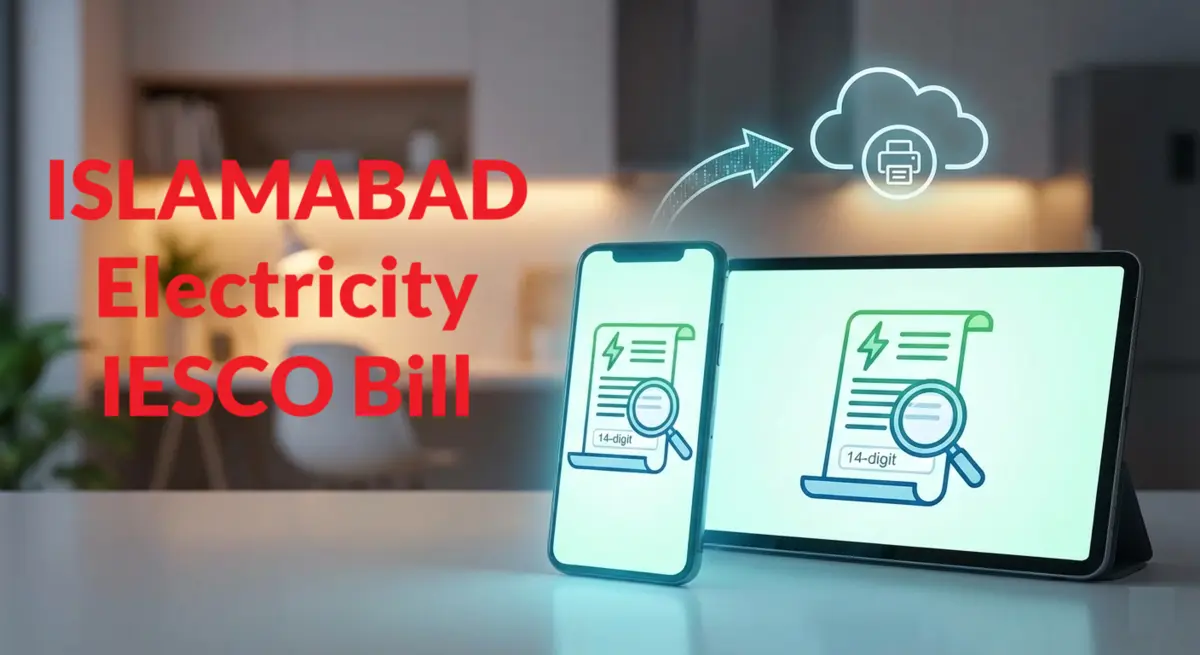
Are you looking to check your IESCO bill online? You’re in the right place! On this page, you can easily view, download, and print your IESCO duplicate bill using your 14-digit reference number on the bill. Whether you’ve lost your paper bill or want to stay ahead of your due date, eBillPakistan.com provides a free, fast, and secure way to access your Islamabad Electric Supply Company (IESCO) bill.
About IESCO: Powering Pakistan’s Capital Region
Islamabad Electric Supply Company (IESCO) stands as one of Pakistan’s most significant electricity distribution companies, serving the twin cities of Islamabad and Rawalpindi along with extensive areas of Punjab and Azad Jammu & Kashmir. Established to ensure reliable power distribution across strategically important regions, IESCO manages the complete electricity supply chain from procurement to consumer billing for residential, commercial, industrial, and agricultural customers.
How to Check Your IESCO Bill Online: Complete Guide
View your IESCO web bill requires lesser effort and can be completed within moments using any internet-enabled device. Follow this comprehensive process to retrieve your billing information:
- Gather Your Reference Number: Locate the 14-digit customer reference number printed prominently on any previous IESCO bill or your meter installation document
- Choose Your Platform: Navigate to the official IESCO website, authorized bill checking portals, or mobile applications that support IESCO billing services
- Enter Accurate Details: Input your complete reference number carefully, double-checking each digit to avoid errors that prevent bill retrieval
- Retrieve Bill Information: View your current month’s billing details including consumption units, charges breakdown, due date, and payment status
- Access Duplicate Bills: The same process allows you to obtain a duplicate bill IESCO if your physical copy was lost, damaged, or never delivered
- Download and Save: Most platforms offer PDF download options allowing you to save digital copies for record-keeping and payment processing
- Verify All Details: Cross-reference the billing amount, meter reading, consumption units, and any additional charges before proceeding to payment
- Check Payment History: Many portals display previous months’ bills and payment records, helping you track your electricity expense trends over time

Residential Tariff Slabs Breakdown
For residential consumers, IESCO implements a progressive tariff system where the per-unit electricity cost increases as monthly consumption rises. This structure incentivizes energy conservation while keeping basic electricity affordable:
| Consumption Slab | Monthly Units (kWh) | Tariff Characteristics |
|---|---|---|
| Lifeline Consumers | 0 – 50 units | Heavily subsidized rate for low-income households |
| Slab 1 | 51 – 100 units | Basic residential rate for minimal consumption |
| Slab 2 | 101 – 200 units | Moderate rate for average household consumption |
| Slab 3 | 201 – 300 units | Increased rate as consumption rises |
| Slab 4 | 301 – 700 units | Higher rate for above-average consumption |
| Slab 5 | Above 700 units | Maximum rate for high-consumption households |
Important Note on Slab Calculation: IESCO applies weighted average calculation for residential bills. This means you don’t pay the highest slab rate on all units consumed—instead, units in each slab are charged at their respective rates. For example, if you consume 250 units, the first 100 units are charged at lower slab rates, the next 100 at mid-tier rates, and remaining 50 at the third slab rate, resulting in an averaged per-unit cost that’s more equitable than flat high-rate billing.
Common IESCO Billing Issues and Solutions
Consumers frequently encounter specific billing challenges that require understanding and appropriate action for resolution. Recognizing these issues early prevents payment complications and service disruptions:
| Common Problem | Typical Causes | Recommended Resolution Steps |
|---|---|---|
| Abnormally High Bill | Faulty meter, estimation errors, increased usage, unauthorized connections | Verify meter reading accuracy, check for appliance malfunctions, request meter testing, compare with previous months |
| Bill Not Generated | Meter reader access issues, system errors, database updates | Contact IESCO helpline, visit nearest customer center, verify connection status |
| Reference Number Invalid | Recent new connection, number change, database synchronization delay | Verify number from physical bill, wait 24-48 hours after connection, contact customer service |
| Estimated Bill | Meter reader unable to access premises, locked gates, aggressive dogs | Ensure meter accessibility, provide actual reading to IESCO, request adjustment in next bill |
| Payment Not Reflecting | Bank processing delays, incorrect reference number entry, weekend payments | Retain payment receipts, allow 2-3 working days, verify reference number accuracy |
| Duplicate Billing | System errors, meter replacement, connection changes | Document both bills, file formal complaint with evidence, request bill cancellation |
| Wrong Tariff Category | Connection conversion not updated, database errors | Submit category correction request with supporting documents at subdivision office |
| Fuel Adjustment Confusion | Quarterly FPA variations, lack of consumer awareness | Understand FPA is regulatory requirement, check NEPRA notifications for approved rates |

IESCO Service Territory and Regional Offices
Understanding IESCO’s geographical coverage and regional office structure helps consumers identify their relevant service centers for in-person assistance. The service territory is divided into circles, divisions, and subdivisions for administrative efficiency:
| Region/Circle | Major Areas Covered | Key Service Centers |
|---|---|---|
| Islamabad Circle | ICT sectors, rural Islamabad, surrounding villages | G-6, I-8, Tarnol, Nilore, Bhara Kahu subdivisions |
| Rawalpindi City Circle | Urban Rawalpindi, cantonment areas, commercial zones | Saddar, Commercial Market, Westridge, Chaklala subdivisions |
| Rawalpindi Cantt Circle | Military installations, cantonment residential areas | Multiple cantonment-specific subdivisions |
| Attock Circle | Attock city and district tehsils | Attock City, Hazro, Fatehjang subdivisions |
| Jhelum Circle | Jhelum city, district areas, GT Road corridor | Jhelum City, Sarai Alamgir, Dina subdivisions |
| Chakwal Circle | Chakwal district and surrounding rural areas | Chakwal City, Talagang, Choa Saidan Shah subdivisions |
| AJK Region | Selected areas of Azad Kashmir under IESCO jurisdiction | Designated AJK subdivisions |
IESCO’s Digital Transformation and Mobile Applications
IESCO has embraced digital technology to enhance customer experience and operational efficiency. Several official and third-party platforms now support check IESCO bill online functionality alongside additional services. The IESCO official website provides the primary portal for bill checking, payment status verification, and consumer information access.
Peak Hours and Load Management
Understanding electricity demand patterns and peak consumption hours helps consumers optimize usage timing for potential future time-of-use tariffs and current load management:
| Time Period | Load Characteristics | Consumer Strategy |
|---|---|---|
| Morning Peak (7-10 AM) | High residential demand as people prepare for work/school | Minimize heavy appliance use during this window |
| Midday (10 AM – 4 PM) | Commercial peak, residential demand moderate | Good time for running washers, dryers, dishwashers |
| Evening Peak (6-11 PM) | Maximum system-wide demand, highest load stress | Avoid simultaneous operation of AC, iron, water heater |
| Night Hours (11 PM – 6 AM) | Lowest overall demand, minimal grid stress | Ideal for charging devices, running deferred appliances |
Understanding Meter Types and Technology
IESCO deploys various meter technologies across its consumer base, each with distinct characteristics affecting reading methods and billing accuracy:
- Electromechanical Meters: Traditional spinning disk meters still prevalent in older installations, require manual reading by meter readers
- Digital Electronic Meters: LCD display meters providing direct numerical readout, improving reading accuracy and reducing human error
- Smart Prepaid Meters: Advanced meters requiring advance payment through recharge cards or digital tokens, eliminating post-consumption billing
- AMR (Automatic Meter Reading) Meters: Equipped with communication modules enabling remote reading without physical access, gradually being deployed
- Net Metering Systems: Bidirectional meters for solar panel installations, measuring both consumption and grid export for billing adjustment
Conclusion: Empowering IESCO Consumers Through Information
Mastering the IESCO bill check process represents far more than administrative convenience—it’s a fundamental tool for financial planning, energy awareness, and proactive household management. By regularly performing your electricity bill online check IESCO and understanding the comprehensive billing ecosystem detailed in this guide.
Need Help?
If your IESCO bill isn’t loading, double-check your reference number (without spaces).
Still facing issues? Visit the official IESCO website or contact the nearest IESCO office.