
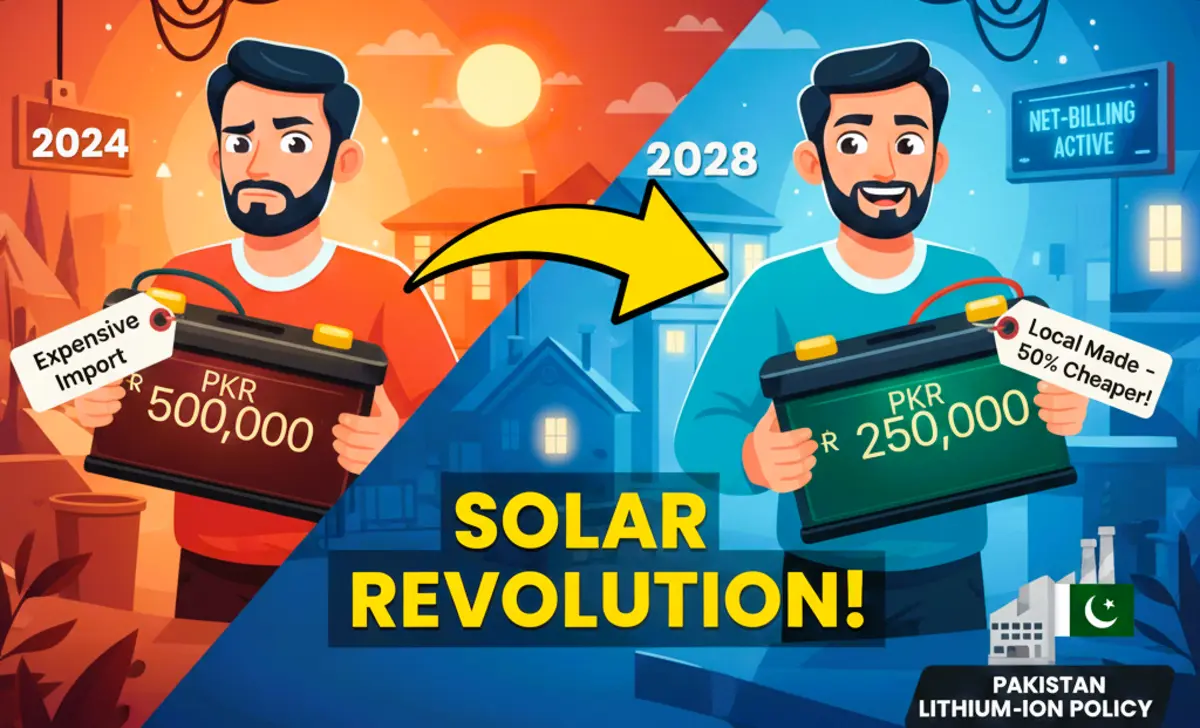
Solar users alert! Your battery costs could drop 30-50% by 2028, thanks to Pakistan’s new National Lithium-Ion Battery Policy. Say goodbye to expensive imports and hello to local manufacturing, tax breaks, and incentives that make full solar independence affordable. But with net-metering ending and net-billing starting, storage is now your power bank. Don’t upgrade without reading this first!

What is the National Lithium-Ion Battery Policy 2026-2031?
Finalized January 2026, this federal policy promotes domestic lithium-ion battery manufacturing to cut import reliance (currently 95%). Focuses on Lithium Iron Phosphate (LFP) tech for safety and longevity. Key goals:
- Phased localization: 30% local content by 2028, 70% by 2031
- Tariff reforms: Duty reductions on raw materials, finished batteries
- Performance incentives: Subsidies for factories meeting targets
- Testing/certification framework + recycling standards
- B2B deals with China for tech transfer
💰 Price Impact: Solar Battery Costs to Halve
| Current (2026 Import) | Projected 2028 (Local) | Savings |
|---|---|---|
| 5kWh LFP: Rs480,000 | Rs250,000-300,000 | 38-48% |
| 10kWh LFP: Rs900,000 | Rs500,000-600,000 | 33-44% |
| 20kWh Commercial: Rs1.8M | Rs1M-1.2M | 33-44% |
🏠 What Changes for Residential Solar Users?
- Net-Metering Ends (July 2026): No more free grid export at Rs34/unit. Shift to net-billing (buy low, sell low ~Rs13/unit)
- Battery Storage Essential: Store daytime solar for night/peak use (6-10PM Rs24/unit)
- Hybrid Systems Mandatory: Solar + Lithium = zero LESCO bills year-round
- ROI Improves: Batteries pay back in 3-4 years vs 5-7 years currently
🏭 Benefits for Commercial/Industrial Users
| Industry | Policy Impact | Annual Savings |
|---|---|---|
| Textile Mills | Peak shaving + ToU arbitrage | Rs10-20M |
| Steel Plants | Grid stability + captive solar | Rs50M+ |
| Cold Storage | 24/7 backup + net-billing | Rs5-8M |
📋 Step-by-Step: Upgrade Your Solar System
- Assess Needs: Calculate daily consumption (fridge/AC = 5-10kWh storage)
- Choose LFP Batteries: 6000+ cycles, 10-15 year life, Pakistan heat resistant
- Hybrid Inverter: 5-10kW with MPPT (Rs250K-500K)
- Apply Net-Billing: NEPRA approval (1MW limit per connection)
- Monitor via App: Smart BMS for 95% efficiency
⚠️ Challenges & Risks
- Initial import prices may rise before local production scales
- Quality certification crucial – avoid cheap Chinese fakes
- Recycling infrastructure 2-3 years away
- Grid upgrades needed for BESS integration
🚀 Timeline: What to Expect
| 2026 | 2027-28 | 2029-31 |
|---|---|---|
| Policy launch 1st factories 30% localization | Price drop 30% 50% local content Export starts | 70% localization Regional hub EV integration |
💡 Action Plan for Solar Owners
- Now (Q1 2026): Install hybrid inverter if basic net-metering
- Q2 2026: Add 5kWh LFP before net-billing transition
- 2027: Expand to 10-20kWh as prices fall
- Monitor: EDB/BOI websites for incentive updates
📞 Key Contacts & Resources
- Engineering Development Board (EDB): +92-51-9205620
- NEPRA Solar Helpline: 051-9260468
- Policy Draft: edb.gov.pk/battery-policy
- LESCO Net-Billing: lesco.gov.pk/net-billing
Updated: January 22, 2026 | Policy analysis for 1M+ solar users | Sources: EDB, NEPRA, Profit Pakistan, Dawn

Farhan Shafique is a Pakistan-based researcher and content writer specializing in electricity billing systems and public utility services. He has spent years studying billing structures, tariff calculations, and consumer rights to help people better understand their monthly bills. Through detailed guides and step-by-step explanations, he aims to simplify complex utility processes for everyday users.