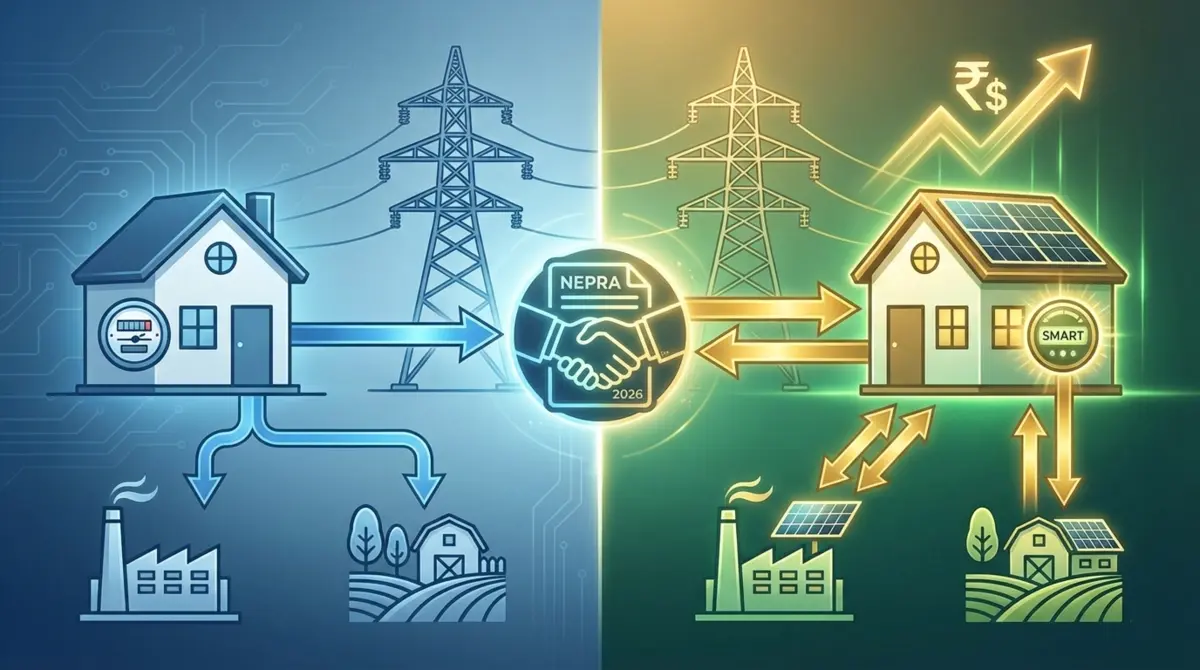
The National Electric Power Regulatory Authority (NEPRA) has notified sweeping changes to Pakistan’s distributed generation framework through the Prosumer Regulations 2026, issued on February 9, 2026. The new regulations replace the previous Alternative and Renewable Energy Distributed Generation and Net Metering Regulations 2015, introducing a fundamental shift from net metering to net billing arrangements for solar energy prosumers across the country.
Under the NEPRA Prosumer Regulations 2026, a prosumer is defined as an electricity consumer who generates power through distributed generation facilities and has entered into an agreement with a distribution licensee. The regulations specifically cover three-phase 400V or 11kV consumers across multiple categories including domestic, commercial, industrial, agricultural, and general services sectors.
The transition from net metering to net billing represents the most significant change in the new prosumer regulations. This fundamental shift affects how electricity generation and consumption are measured, billed, and compensated for distributed generation facilities.
According to Regulation 14 of the NEPRA Prosumer Regulations, net billing operates on a dual-rate system where electricity flows are valued differently based on direction:
Download the full PDF of Prosumer Regulations 2026 .
Application and Interconnection Process Timeline The NEPRA Prosumer Regulations establish clear deadlines for each stage of the application and interconnection process, providing transparency and accountability for both prosumers and distribution licensees.
Process Stage Timeline Responsible Party Information provision to applicant 2 working days Licensee Application acknowledgment 5 working days Licensee Missing information submission 3 working days Applicant Initial technical review 15 working days Licensee Agreement execution 7 working days Both parties Connection charge estimate issuance 7 working days Licensee Payment of connection charges 7 working days Prosumer Interconnection facility installation 15 working days Licensee Authority concurrence 7 working days NEPRA
Capacity Limits and Technical Requirements The prosumer regulations impose specific capacity constraints and technical standards to ensure grid stability and safety across Pakistan’s electricity distribution network.
Installation Capacity Restrictions Maximum distributed generation facility size: one megawatt Capacity cannot exceed the sanctioned load of the consumer premises Distribution transformer loading limited to 80 percent of rated capacity NEPRA retains authority to revise capacity limits through future notifications Protection and Safety Standards The NEPRA Prosumer Regulations mandate compliance with international safety standards for distributed generation equipment:
Grid-connected inverters must comply with Underwriters Laboratories UL 1741 standard Voltage variation tolerance: plus or minus 5 percent of nominal voltage Frequency variation tolerance: plus or minus 1 percent of nominal frequency Automatic disconnection mechanisms required for grid fault conditions Manual disconnect device with visual break mandatory for isolation Protection diagrams subject to licensee approval before commissioning Financial Obligations and Fee Structure The new prosumer regulations outline comprehensive financial responsibilities for both prosumers and distribution companies throughout the interconnection and operation phases.
Prosumer Cost Responsibilities All interconnection facility costs up to the interconnection point Metering installation and equipment expenses Distribution system improvements required solely for interconnection One-time concurrence fee of Rs. 1,000 per kilowatt to NEPRA Operating and maintenance costs for distributed generation facility Load flow study costs for installations 250 kilowatt and above Meter Procurement Options The regulations provide flexibility in metering arrangements to accommodate equipment availability constraints. Distribution licensees must install meters capable of measuring bidirectional electricity flow. In cases where licensees cannot provide suitable meters, prosumers may directly procure meters subject to testing and approval by the distribution company before installation.
Agreement Terms and Renewal Process The NEPRA Prosumer Regulations establish a standardized framework for agreements between prosumers and electricity distribution licensees across Pakistan.
Agreement Aspect Details Initial Term Five years from commissioning date Renewal Successive five-year terms with mutual consent Prosumer Termination 30 days written notice Licensee Termination 30 days written notice with NEPRA approval Fresh Concurrence Required for technical parameter modifications Concurrence Validity Six months to commence generation
Transition Provisions for Existing Net Metering Consumers The NEPRA Prosumer Regulations include specific transition arrangements for consumers who installed distributed generation facilities under the previous net metering framework.
“The distributed generators having valid agreements executed under the repealed regulations, shall be billed in accordance with the national average power purchase price till the expiry of the term of their agreement and thereafter shall be billed in accordance with the national average energy purchase price for all future renewals.”
NEPRA Prosumer Regulations 2026, Regulation 21 Key Transition Points Existing net metering agreements remain valid until expiry Billing transitions to net billing arrangement from the billing cycle following February 2026 Current agreements compensated at national average power purchase price until expiry Agreement renewals subject to new prosumer regulations and net billing rates National average energy purchase price applies to all future renewals Rights and Obligations of Distribution Licensees The prosumer regulations delineate specific responsibilities for electricity distribution companies to facilitate distributed generation interconnection while maintaining grid reliability and safety standards.
Licensee Obligations Allow eligible consumers to establish distributed generation facilities Provide bidirectional metering or dual meter configurations Review and approve distributed generation facility designs Grant interconnection approval within regulatory timelines Implement validation checks to monitor unauthorized capacity extensions Conduct pre-commissioning inspections of prosumer facilities Provide information and approved documents within two working days Disconnection Rights Distribution licensees retain the authority to disconnect or limit prosumer facilities under specific circumstances outlined in the NEPRA Prosumer Regulations:
Immediate disconnection without notice in case of electrical faults Thirty-day notice disconnection for routine maintenance or distribution system modifications Disconnection upon determination of non-compliance with regulations Disconnection following agreement termination or expiry Prosumer Rights and Responsibilities The regulations establish clear expectations for prosumers operating distributed generation facilities connected to Pakistan’s electricity distribution network.
Operational Requirements Operate and maintain facilities according to prudent electrical practices Install protection equipment meeting NEPRA-approved specifications Provide forty working days notice for material modifications Allow licensee access for inspection and testing at reasonable times Prevent interference with distribution system operations Take corrective action for equipment causing grid interference Notify licensee fifteen working days before interconnection Insurance and Liability Prosumers must obtain and maintain appropriate insurance coverage for third-party personal injury and general commercial liability. The regulations establish mutual indemnification provisions where each party defends and indemnifies the other against losses arising from their respective facilities and operations.
Dispute Resolution Mechanism The NEPRA Prosumer Regulations designate the National Electric Power Regulatory Authority as the sole arbiter for disputes between prosumers and distribution licensees. Any disagreement relating to activities covered under the regulations must be submitted to NEPRA for decision, providing a centralized mechanism for conflict resolution in Pakistan’s distributed generation sector.
Enforcement and Penalties The regulations incorporate enforcement mechanisms to ensure compliance by prosumers and distribution licensees across Pakistan’s electricity sector.
Penalties for failure to comply with regulatory provisions Sanctions for refusal to comply with NEPRA directions or orders Punishments under the Regulation of Generation, Transmission and Distribution of Electric Power Act 1997 NEPRA authority to require information from licensees and prosumers at any time Power to issue directions, instructions, and guidelines for regulatory compliance Load Flow Study Requirements For larger distributed generation installations, the NEPRA Prosumer Regulations mandate comprehensive technical assessments to evaluate grid impact and ensure safe interconnection.
“An applicant proposing to install a distributed generation facility with an installed capacity of 250 kW or above shall be obligated to conduct and submit a load flow study carried out through the licensee or any reputable consultant registered with Pakistan Engineering Council.”
NEPRA Prosumer Regulations 2026, Regulation 3(3) This requirement ensures that installations exceeding 250 kilowatts undergo rigorous technical evaluation by qualified professionals before interconnection approval, protecting grid stability and reliability across the distribution network.
Also read: How to Manage Peak and Off-Peak Hours Consumption
Metering Standards and Reading Procedures The prosumer regulations establish specific metering requirements to accurately measure electricity flows in both directions between distributed generation facilities and the distribution grid.
Metering Equipment Standards Bidirectional meters capable of accurately measuring electricity flow in two directions Alternative dual-meter configuration with separate import and export meters Equipment must meet NEPRA-approved safety and protection requirements Dual-meter calculations must yield identical results to single bidirectional meters Preferential meter reading through handheld units or automated systems NEPRA authority to direct specific metering technologies from time to time Impact on Pakistan’s Renewable Energy Sector The introduction of the NEPRA Prosumer Regulations 2026 represents a significant policy shift for Pakistan’s distributed renewable energy landscape. The transition from net metering to net billing fundamentally changes the economic proposition for residential, commercial, and industrial solar installations across the country.
Industry experts anticipate that the new compensation mechanism, which pays prosumers the national average energy purchase price rather than retail tariff rates, will extend payback periods for distributed generation investments. However, the regulations provide regulatory clarity and standardized procedures that may encourage institutional and commercial sector participation in distributed generation.
NEPRA’s Authority to Modify Regulations The prosumer regulations grant NEPRA broad powers to adapt the framework in response to evolving market conditions and technological developments in Pakistan’s electricity sector.
Authority to revise capacity limits through notification Power to modify compensation rates during agreement terms Ability to relax regulatory provisions for specific cases Authority to issue directions, instructions, and guidelines Power to remove difficulties in implementing regulations Capacity to require information from licensees and prosumers Conclusion The NEPRA Prosumer Regulations 2026 establish a comprehensive framework for distributed generation in Pakistan, replacing the previous net metering system with a net billing arrangement. While the new regulations provide clear procedures and timelines for interconnection, the fundamental shift in compensation methodology marks a significant change for existing and prospective solar energy prosumers across the country.
Stakeholders in Pakistan’s renewable energy sector will need to carefully evaluate the financial implications of net billing compared to the previous net metering framework. The regulations’ transition provisions offer existing consumers some continuity, while new applicants must navigate the updated economic model for distributed generation investments.
As Pakistan continues developing its renewable energy capacity, the NEPRA Prosumer Regulations 2026 will play a crucial role in shaping the distributed generation landscape for years to come.
For the complete text of the NEPRA Prosumer Regulations 2026, stakeholders should refer to SRO 251(I)/2026 published in the official Gazette on February 9, 2026.
Farhan Shafique is a Pakistan-based researcher and content writer specializing in electricity billing systems and public utility services. He has spent years studying billing structures, tariff calculations, and consumer rights to help people better understand their monthly bills. Through detailed guides and step-by-step explanations, he aims to simplify complex utility processes for everyday users.