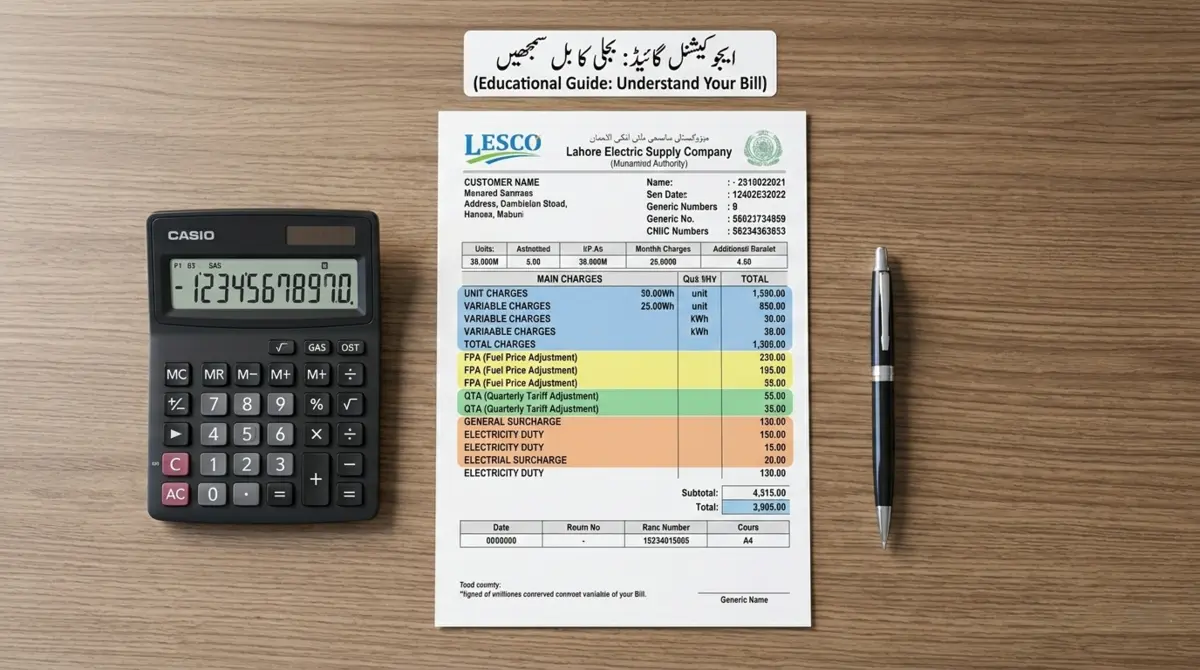
Opening your LESCO bill and seeing a bunch of mysterious charges like FPA, QTA, NJ Surcharge, and other abbreviations you didn’t sign up for is confusing. You consumed 300 units but somehow your bill is double what you expected. What are all these extra charges, why do they keep changing every month, and is LESCO allowed to just add random fees whenever they want?
Most people in Lahore just pay their LESCO bill without understanding what half the charges mean. But these “adjustments” and “surcharges” can add 30-60% to your base electricity cost. Once you understand what each charge actually represents, you can spot billing errors, plan your budget better, and know when LESCO is overcharging versus when the charges are legitimate.

What Your LESCO Bill Actually Shows
Before diving into specific charges, let’s understand the basic structure of a LESCO electricity bill. You can check your current bill anytime on eBillPakistan by entering your 14-digit reference number—it’s the same bill LESCO generates, just viewable online without waiting for the paper copy.
Main sections on every LESCO bill:
- Consumer Information: Your name, address, reference number, connection type
- Meter Reading Details: Previous reading, current reading, units consumed
- Electricity Charges: Base tariff cost for units consumed
- Adjustments and Surcharges: FPA, QTA, NJ Surcharge, and others
- Government Taxes: GST, income tax (if applicable), other levies
- Total Amount Payable: Everything added up
- Due Date: Last date to pay without late charges
The confusion happens in that “Adjustments and Surcharges” section where FPA, QTA, and other charges appear. These aren’t fixed amounts—they change every month, sometimes dramatically.
Understanding FPA (Fuel Price Adjustment)
FPA is usually the biggest variable charge on your LESCO bill and the one that causes the most shock when it spikes.
What FPA actually is:
Fuel Price Adjustment reflects changes in the cost of fuel used to generate electricity. When oil prices go up internationally, or when Pakistan imports expensive LNG, those costs get passed to consumers through FPA. When fuel costs drop, FPA decreases (though never as much as it increases, let’s be honest).
NEPRA (National Electric Power Regulatory Authority) calculates FPA monthly based on actual fuel costs. LESCO doesn’t decide this amount—it’s imposed uniformly across all distribution companies.
How FPA is calculated:
- FPA is charged per unit of electricity consumed
- Typical FPA ranges from PKR 2-8 per unit, but can go higher during extreme fuel price spikes
- Your total FPA = (Units consumed × FPA rate for that month)
- FPA applies to all consumer categories—residential, commercial, industrial
Example FPA calculation:
- You consumed 350 units
- FPA for the month is PKR 5.50 per unit
- Your FPA charge = 350 × 5.50 = PKR 1,925
“FPA is the single biggest reason LESCO bills fluctuate wildly month to month even when consumption stays the same. In January your FPA might be PKR 3 per unit, by June it’s PKR 7 per unit. That’s why your bill doubles without using more electricity.”
Why FPA keeps changing:
- International oil prices fluctuate constantly
- Pakistan’s fuel mix changes based on availability—more imported LNG means higher FPA
- Exchange rate matters—when rupee weakens against dollar, imported fuel costs more
- Seasonal demand affects which power plants run (expensive ones run during peak summer)
- Government energy policy decisions impact fuel procurement costs
You can’t avoid FPA—it’s mandatory for all LESCO consumers in Lahore. But understanding it helps you budget for months when FPA is typically higher (summer) versus lower (winter/spring).
What is QTA (Quarterly Tariff Adjustment)
QTA is newer than FPA and many LESCO consumers in Lahore don’t even know what it stands for, much less why it’s on their bill.
QTA explained simply:
Quarterly Tariff Adjustment accounts for the difference between LESCO’s projected costs and actual costs over a quarter (three months). If LESCO’s operational expenses—maintenance, salaries, infrastructure—are higher than what was built into the base tariff, QTA recovers that shortfall from consumers.
Unlike FPA which changes monthly, QTA is calculated quarterly and then applied for the next quarter.
How QTA works:
- NEPRA reviews LESCO’s quarterly financial data
- If actual costs exceeded projected costs, a positive QTA is charged
- If LESCO spent less than projected, a negative QTA gives consumers a discount (rare but happens)
- QTA is charged per unit, similar to FPA
- Typical QTA ranges from PKR 0.50 to PKR 3 per unit
QTA vs FPA differences:
| Aspect | FPA | QTA |
|---|---|---|
| Frequency | Monthly | Quarterly |
| What it covers | Fuel cost changes | Operational cost changes |
| Typical amount | PKR 2-8 per unit | PKR 0.50-3 per unit |
| Who determines it | NEPRA based on fuel costs | NEPRA based on LESCO finances |
| Can be negative | Rarely | Sometimes (discount) |
QTA is less predictable than FPA because it depends on LESCO’s internal operations, not just external fuel prices. If LESCO had major infrastructure repairs one quarter, QTA might spike the next quarter to recover those costs.

NJ Surcharge (Neelum-Jhelum Surcharge)
This one confuses everyone. Why are LESCO consumers in Lahore paying for a hydroelectric project way up in Azad Kashmir?
What NJ Surcharge is:
The Neelum-Jhelum Hydropower Project is a massive 969 MW hydroelectric dam that cost billions of dollars to build. To recover the construction costs and ongoing operational expenses, the government imposed a surcharge on all electricity consumers across Pakistan, including LESCO customers.
The project generates cheap hydroelectric power, but consumers pay the surcharge whether they actually get that hydro power in their mix or not. It’s essentially a loan repayment scheme spread across the entire country’s electricity bills.
NJ Surcharge details:
- Fixed amount per unit, doesn’t fluctuate monthly like FPA
- Currently around PKR 0.10-0.30 per unit (amount can change based on government decisions)
- Applied to all consumer categories nationwide
- Will continue until project costs are recovered (could be years)
- Shows up as separate line item on LESCO bills
Example NJ Surcharge on 300 units:
- 300 units × PKR 0.20 per unit = PKR 60 total NJ Surcharge
Compared to FPA and QTA, NJ Surcharge is small. But it adds up over time and it’s completely separate from your actual electricity consumption needs—you’re funding infrastructure whether you benefit from it or not.
“People in Lahore ask why they’re paying for a dam in Kashmir when they don’t even get that electricity. The answer is the government spread the cost burden nationally to make the project financially viable. Fair or not, it’s on everyone’s bill.”
Other Common Charges on LESCO Bills
Beyond FPA, QTA, and NJ Surcharge, your LESCO bill has other charges worth understanding.
GST (General Sales Tax):
- Currently 18% on total electricity charges
- Applied to base tariff + FPA + QTA + all other charges
- GST alone can add PKR 1,500-3,000 to a typical household bill
- Mandatory government tax, LESCO just collects it
Income Tax (Withholding Tax):
- Applied if your monthly consumption exceeds certain thresholds
- Adjustable against your annual income tax return if you file
- Non-filers pay higher withholding tax rates
- Only applies to higher consumption brackets
TV Fee:
- PKR 35 monthly for Pakistan Television license
- Mandatory for all domestic connections
- Yes, even if you don’t watch PTV
- One of those “we’ve always done it this way” charges
Meter Rent:
- Small monthly charge for meter maintenance
- Usually PKR 15-25 depending on meter type
- Covers meter reading and maintenance costs
Late Payment Surcharge:
- If you miss the due date, LESCO adds late payment penalties
- Usually 5-10% of total bill amount
- Avoidable by paying on time
Sample LESCO Bill Breakdown
Let’s break down a real example so you can see how all these charges add up on a typical LESCO bill for a Lahore household.
Consumption: 350 units
| Charge Type | Calculation | Amount (PKR) |
|---|---|---|
| Base Electricity Charges | 350 units at slab rates | 5,250 |
| FPA | 350 × PKR 5.50 | 1,925 |
| QTA | 350 × PKR 1.20 | 420 |
| NJ Surcharge | 350 × PKR 0.20 | 70 |
| Subtotal | Before taxes | 7,665 |
| GST (18%) | 7,665 × 0.18 | 1,380 |
| TV Fee | Fixed monthly | 35 |
| Meter Rent | Fixed monthly | 20 |
| Total Bill | Everything combined | 9,100 |

Notice how 350 units with a base cost of PKR 5,250 becomes PKR 9,100 after all charges and taxes. That’s a 73% increase over the base rate. This is why people feel like their LESCO bills are way higher than their actual consumption would suggest.
Why These Charges Keep Increasing
If you’ve been paying LESCO bills in Lahore for a few years, you’ve noticed the trend—charges mostly go up, rarely down. Here’s why.
Factors driving increases in FPA, QTA, and other charges:
- Pakistan’s energy mix is expensive: We rely heavily on imported fuel and LNG rather than cheaper domestic sources
- Rupee depreciation: When rupee weakens against dollar, imported fuel costs more in PKR terms
- Circular debt: Energy sector debt keeps growing, costs get passed to consumers through various adjustments
- Infrastructure decay: Old transmission lines lose 15-20% of electricity, losses get recovered through tariffs
- Theft and non-payment: Line losses from theft and uncollected bills get distributed across paying consumers
- IMF conditions: International lenders require Pakistan to reduce energy subsidies, meaning higher consumer tariffs
- Capacity payments: Pakistan pays power plants even when they’re not generating, these costs show up in adjustments
“Every time the government negotiates with IMF, electricity gets more expensive for regular consumers. Subsidies get cut, tariffs get adjusted upward, and FPA becomes the mechanism to pass all these costs down the chain to your monthly bill.”
Are These Charges Legal and Fair
Short answer: Yes, they’re legal. NEPRA approves all these charges. Whether they’re fair is a different question that lots of LESCO consumers in Lahore debate.
Legal framework:
- NEPRA (National Electric Power Regulatory Authority) is the legal body that approves tariffs and adjustments
- FPA, QTA, and other charges are determined through NEPRA hearings with public input (theoretically)
- LESCO must implement NEPRA-approved charges, it can’t just make up fees
- All charges should be itemized on your bill—if something isn’t listed, you can challenge it
Consumer rights:
- You have the right to understand what you’re being charged for
- LESCO must provide detailed billing showing how charges were calculated
- You can file complaints with NEPRA if charges seem incorrect
- If LESCO applies wrong tariff category or overcharges, you can dispute and get refund
The problem isn’t usually that charges are illegal, but that they’re poorly communicated. Most people have no idea what FPA or QTA mean, so when bills spike they assume it’s an error when really it’s approved adjustments kicking in.
How to Spot Billing Errors
Now that you understand what charges should be on your LESCO bill, here’s how to spot when something is actually wrong versus when it’s just higher than expected but legitimate.
Red flags that indicate billing errors:
- Meter reading is wrong: Check your physical meter, if it shows 15000 but bill says 18000, that’s an error
- Units consumed don’t match meter difference: Current reading minus previous reading should equal units charged
- FPA per unit is wildly different from last month: FPA changes but not usually by PKR 5-6 per unit month to month—check NEPRA announcements
- Charges listed that aren’t explained: If there’s a “special surcharge” or mystery charge with no description, question it
- Wrong tariff category applied: If you’re residential but charged commercial rates
- Previous arrears added incorrectly: Old bills showing up even though you paid them
How to verify your bill is accurate:
- Check bill on eBillPakistan to see all charges breakdown clearly
- Physically read your meter and confirm it matches bill
- Calculate units yourself: current reading – previous reading
- Look up current FPA and QTA rates on NEPRA website to verify they match your bill
- Compare your bill to previous months—sudden huge jumps (50%+) without explanation warrant investigation
- Ask neighbors if their bills also spiked—if yes, probably a legitimate FPA increase; if only yours, possible error

What to Do If Your Bill Seems Wrong
If you’ve checked everything and genuinely believe your LESCO bill has errors, here’s the complaint process.
Step 1: Gather evidence
- Photo of your current meter reading
- Copy of disputed bill from eBillPakistan
- Copies of previous bills showing normal consumption
- Notes on what specifically is wrong
Step 2: Contact LESCO customer service
- Call LESCO helpline 118
- Visit your nearest LESCO customer care center in Lahore
- Use LESCO online complaint portal
- Reference your 14-digit consumer number from your bill
Step 3: File formal complaint
- Explain the specific error (wrong meter reading, incorrect FPA calculation, etc.)
- Provide evidence you gathered
- Get a complaint reference number
- LESCO should respond within 7-15 days
Step 4: Escalate if needed
- If LESCO doesn’t resolve within 30 days, file complaint with NEPRA
- NEPRA has consumer complaint portal specifically for billing disputes
- NEPRA can force LESCO to correct errors and issue refunds
Tips to Reduce Your Overall LESCO Bill
You can’t control FPA, QTA, or NJ Surcharge—those are imposed on everyone. But you can reduce your base consumption, which reduces what all those per-unit charges apply to.
Practical ways to lower LESCO bills in Lahore:
- Stay under 200 units monthly: Protected consumer status gets lower rates and reduced FPA impact
- Use electricity during off-peak hours: Some LESCO tariffs charge less for off-peak consumption
- Switch to LED lighting: Reduces consumption by 60-80% versus old bulbs
- Service your AC annually: Poorly maintained ACs consume 20-30% more electricity
- Use inverter appliances: Inverter ACs and fridges use 30-50% less electricity
- Unplug unused devices: Standby power consumption adds 5-10% to bills
- Improve home insulation: Reduces AC load and overall consumption
Even small consumption reductions matter because they reduce base charges, FPA, QTA, and the GST calculated on all of them. Cutting 50 units might save PKR 1,000+ when you factor in all the multiplier effects.
Future Changes Coming to LESCO Billing
NEPRA keeps adjusting how electricity gets billed in Pakistan. Here’s what might change in the next few years that affects LESCO consumers in Lahore.
Potential changes to watch:
- Time-of-use pricing: Different rates for peak vs off-peak hours, requires smart meters
- Capacity charges: Fixed charges based on connection size regardless of consumption
- More frequent adjustments: FPA might become weekly instead of monthly in extreme cases
- Digital-only billing: Paper bills might be phased out, everything through platforms like eBillPakistan
- Net metering expansion: If you have solar panels, easier to sell excess back to LESCO
- Tariff rationalization: Government talks about simplifying the complex slab system
Keep checking your bills on eBillPakistan regularly because when these changes roll out, they’ll show up on your bill first, explanations later.
Understanding FPA, QTA, NJ Surcharge, and other charges on your LESCO bill doesn’t make them cheaper, but at least you know what you’re paying for and why. These aren’t random fees LESCO invented—they’re approved adjustments that reflect real costs in Pakistan’s electricity sector, however frustrating they are.
The key takeaway: base electricity charges are just the starting point. Add FPA, QTA, surcharges, and GST, and your actual bill is 50-80% higher than the base rate suggests. Budget accordingly, especially during summer when FPA tends to spike due to expensive fuel consumption for peak cooling demand.

Farhan Shafique is a Pakistan-based researcher and content writer specializing in electricity billing systems and public utility services. He has spent years studying billing structures, tariff calculations, and consumer rights to help people better understand their monthly bills. Through detailed guides and step-by-step explanations, he aims to simplify complex utility processes for everyday users.