
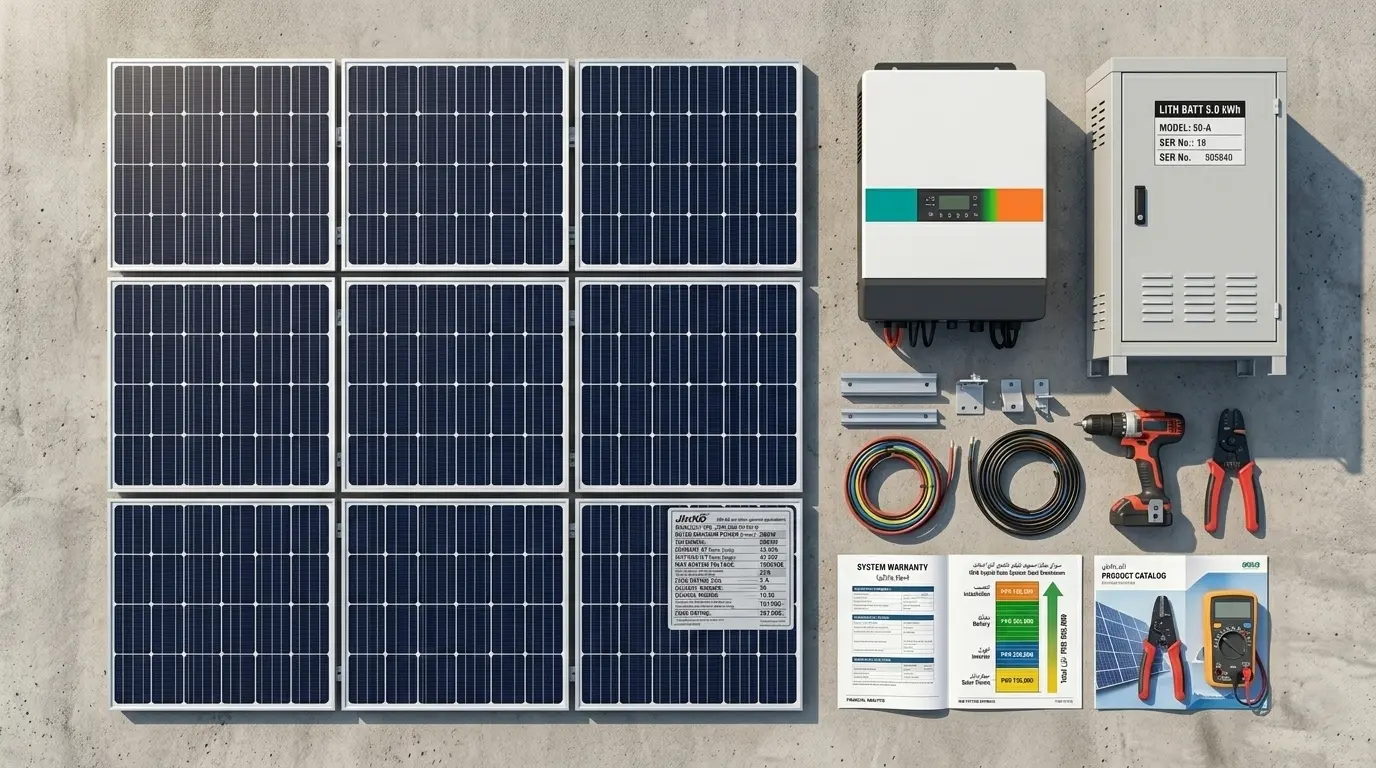
If you’re finding solar system cost for your home in Pakistan and keep seeing different price quotes all over the place, you’re not alone. A 5kW hybrid solar system with lithium batteries costs anywhere from PKR 850,000 to PKR 1,150,000 in March 2026, depending on what brands you pick and where you’re installing. The average total lands around PKR 905,000 for a decent quality setup that’ll actually work during load shedding.
Solar panel prices dropped this year—Tier-1 panels are now PKR 26-28 per watt instead of the PKR 35-40 they used to be. But lithium batteries? Those still cost serious money and make up the biggest chunk of your total bill. Let’s break down exactly where your money goes and what you actually get for PKR 900,000.

What You Get in a 5kW Hybrid System
A 5kW hybrid solar system is the sweet spot for most Pakistani homes using 500-750 units monthly. Check your consumption on eBillPakistan first—if you’re consistently in that range, 5kW is probably right for you.
Daily generation capacity:
- 18-25 units per day depending on your city’s sunshine
- 540-750 units monthly in Lahore/Faisalabad area
- Enough to run AC, refrigerator, water pump, lights, fans during the day
- Battery backup provides 20-40 units for nighttime or load shedding
The “hybrid” part means you get three power sources: solar panels during the day, battery backup when needed, and grid connection as fallback. This is way better than pure on-grid systems that go dead during load shedding.
Complete 5kW Hybrid System Price Breakdown
Here’s exactly where your PKR 905,000 goes when you buy a standard 5kW hybrid solar system in Pakistan in 2026.
| Component | Specifications | Average Price (PKR) | % of Total Cost |
|---|---|---|---|
| Solar Panels | 9 × 585W Tier-1 panels (Jinko/Longi/JA Solar) | 195,000 | 21.5% |
| Hybrid Inverter | 5-6kW with MPPT (Deye/NitroX/GoodWe) | 220,000 | 24.3% |
| Lithium Battery | 5-10kWh LiFePO4 48V (6000+ cycles) | 335,000 | 37% |
| Mounting Structure | GI/L2 angle iron with hardware | 50,000 | 5.5% |
| Wiring & Breakers | DC/AC cables, DB box, MCBs, connectors | 55,000 | 6.1% |
| Installation & Net Metering | Labor, net meter, permits, documentation | 50,000 | 5.5% |
| Total Average Cost | Complete installed system | 905,000 | 100% |
Notice how the lithium battery alone eats up 37% of your total cost. That’s why some people go with cheaper lead-acid tubular batteries at PKR 100,000-150,000 to save money, but lithium lasts 3-4 times longer and performs way better.
Solar Panels: PKR 195,000
For a 5kW system, you need nine 585-watt panels. Panel prices dropped significantly in 2026—Tier-1 brands now cost PKR 26-28 per watt instead of the PKR 35-40 they were a year ago.
What Tier-1 means:
Tier-1 panels come from established manufacturers with proven quality and real warranties. Think Jinko, Longi, JA Solar, Canadian Solar, Trina. They’re not the absolute cheapest, but they actually produce the power they promise and last 25+ years.
Price options for 5kW panels:
- Budget brands (Tier-2/3): PKR 130,000-150,000 for 5kW
- Mid-range (Tier-1 Chinese): PKR 175,000-195,000 for 5kW
- Premium (German/European): PKR 220,000-250,000 for 5kW
Most Pakistani installers use Tier-1 Chinese panels at PKR 195,000 for 5kW. They’re the sweet spot between price and reliability. Paying extra for European panels doesn’t make much sense—the Chinese ones work just as well in Pakistan’s conditions.
Hybrid Inverter: PKR 220,000
The hybrid inverter is the brain of your system. It manages solar panels, batteries, and grid connection all together, switching between sources automatically.
What hybrid inverter does:
- Converts DC power from panels to AC for your home
- Charges batteries from excess solar during the day
- Switches to battery power during load shedding instantly
- Falls back to grid when solar and battery are depleted
- MPPT technology maximizes power extraction from panels
Popular hybrid inverter brands and prices (5-6kW):
| Brand | Model Range | Price Range (PKR) | Quality Tier |
|---|---|---|---|
| Inverex | Nitrox/Aerox series | 160,000 – 190,000 | Budget-friendly |
| Growatt | SPH series | 180,000 – 210,000 | Mid-range |
| Deye | SUN-5/6K-SG04LP3 | 200,000 – 240,000 | Premium |
| GoodWe | GW5048-EM | 220,000 – 260,000 | Premium |
| Huawei | SUN2000 series | 240,000 – 280,000 | Top-tier |

The PKR 220,000 average gets you a Deye or NitroX inverter—both solid choices used by most installers in Lahore, Karachi, and Islamabad. Spending extra for Huawei doesn’t add much value unless you really want the brand name.
Lithium Battery: PKR 335,000 (The Expensive Part)
This is where your money really goes. Lithium batteries cost PKR 335,000 on average for a 5-10kWh system, which is more than your panels and nearly as much as your inverter.
Why lithium costs so much:
- LiFePO4 (Lithium Iron Phosphate) chemistry is expensive but safe and long-lasting
- 6,000-8,000 charge cycles vs 1,000-1,500 for lead-acid
- Lasts 10-15 years vs 3-5 years for tubular batteries
- Higher efficiency (95%+) means less energy wasted
- Lighter weight and smaller size than equivalent lead-acid
Battery capacity and pricing:
| Capacity | Backup Power | Lithium Price (PKR) | Lead-Acid Alternative |
|---|---|---|---|
| 5 kWh | 20-25 units stored | 220,000 – 260,000 | PKR 80,000 (tubular) |
| 7.5 kWh | 30-35 units stored | 300,000 – 350,000 | PKR 110,000 (tubular) |
| 10 kWh | 40-45 units stored | 380,000 – 450,000 | PKR 140,000 (tubular) |
The PKR 335,000 average gets you a 7.5kWh lithium battery, which stores about 30-35 units of electricity. That’s enough to run your essentials (lights, fans, fridge, one AC) for 6-8 hours during evening load shedding.
“Yes, lithium batteries cost triple what tubular batteries do. But tubular batteries die in 3-4 years and you buy them again. Lithium lasts 12-15 years. Over the system’s lifetime, lithium is actually cheaper per year of use.” — Battery specialist, Karachi
Mounting Structure, Wiring & Installation: PKR 155,000
These are the “boring but necessary” costs that people often forget about when budgeting.
Mounting structure (PKR 50,000):
- GI (galvanized iron) or L2 angle iron frame
- Aluminum rails for panel attachment
- Roof mounting hardware, bolts, weatherproofing
- Designed to withstand wind load and weather
Wiring and electrical (PKR 55,000):
- DC cables from panels to inverter (6-10mm² copper)
- AC cables from inverter to home DB
- MC4 connectors for panels
- Circuit breakers (MCBs) for safety
- Distribution box (DB) for clean wiring
- Earthing equipment and surge protection
Installation and net metering (PKR 50,000):
- Professional installation labor (1-2 days work)
- Net metering application and approval fees
- Bidirectional meter installation by LESCO/IESCO/etc.
- System testing and commissioning
- Basic user training on system operation
These costs don’t vary much between companies—everyone needs the same cables, breakers, and mounting hardware. The installation fee might be PKR 40,000-60,000 depending on roof complexity and your location.
Price Range: Why Some Quote PKR 680,000 and Others PKR 1,130,000 for Solar System Cost
You’ll see quotes all over the map for “5kW hybrid solar systems.” Here’s why there’s a PKR 450,000 difference between the cheapest and most expensive.
Budget system (PKR 680,000-750,000):
- Tier-2 Chinese panels (unknown brands)
- Basic Inverex or local inverter
- Small 5kWh lithium battery or lead-acid alternative
- Simple mounting structure
- Minimal warranty (1 year)
Standard system (PKR 850,000-950,000):
- Tier-1 panels (Jinko, Longi, JA Solar)
- Mid-range hybrid inverter (Deye, NitroX, Growatt)
- 7.5kWh lithium LiFePO4 battery
- Quality GI mounting
- 2-3 year component warranty
Premium system (PKR 1,050,000-1,130,000):
- Premium panels (Canadian Solar, LONGi Hi-MO series)
- Top-tier inverter (GoodWe, Huawei, SMA)
- 10kWh high-capacity lithium battery
- Aluminum mounting structure
- 5 year comprehensive warranty
- Monitoring system and app access
The PKR 905,000 average lands you in the “standard” category with quality components that’ll actually last. Going cheaper saves money upfront but costs more long-term when panels underperform and batteries die early.
Regional Price Differences Across Pakistan
Where you install your solar system affects the final price by 5-15%.
| City/Region | Price Adjustment | Reason |
|---|---|---|
| Lahore | Base price + 5% | Higher sales tax, more competition |
| Karachi | Base price + 3-7% | Import costs, K-Electric net metering |
| Islamabad/Rawalpindi | Base price + 8-12% | Smaller market, transportation costs |
| Faisalabad | Base price | Growing solar market, competition |
| Multan/South Punjab | Base price + 5-10% | Transportation, fewer installers |
| Rural areas | Base price – 5% to + 15% | Cheaper labor but higher transport |
Lahore’s Hall Road solar market has the most competitive pricing in Pakistan. If you’re in Karachi or Islamabad, you might save PKR 30,000-50,000 by buying components from Lahore and finding a local installer just for installation.
What’s NOT Included in the Base Price
That PKR 905,000 covers the complete working system, but a few things typically cost extra.
Extended warranty (PKR 40,000-60,000):
- Base price usually includes 1-2 year warranty
- Extended 5-year coverage adds PKR 50,000 average
- Covers panels, inverter, battery, and workmanship
- Worth it for peace of mind on a PKR 900,000 investment
Monitoring system (PKR 15,000-30,000):
- WiFi dongle for inverter connectivity
- Mobile app to track generation and consumption
- Not essential but nice to have
- Some premium inverters include this free
Surge protection upgrades (PKR 10,000-20,000):
- Lightning arrestors for panels and inverter
- Recommended in storm-prone areas
- Basic surge protection usually included
Extra battery capacity (PKR 50,000-100,000 per additional 2.5kWh):
- If 7.5kWh isn’t enough backup
- Can add more battery banks later
- Most people find 7.5-10kWh sufficient
How Much You’ll Actually Save Monthly
Check your last few months of bills on eBillPakistan to see your consumption and per-unit cost. A 5kW hybrid system generating 540-750 units monthly can save you serious money.
Savings calculation example:
- Your current consumption: 650 units monthly (check eBillPakistan)
- Current per-unit rate: PKR 65 average (including FPA, GST, all charges)
- Current monthly bill: 650 × 65 = PKR 42,250
- 5kW solar generates: 650 units monthly
- You use all solar power (hybrid system with battery)
- New monthly bill: PKR 500-1,000 (minimal grid charges)
- Monthly savings: PKR 42,250 – 750 = PKR 41,500
- Annual savings: PKR 41,500 × 12 = PKR 498,000
Payback period:
System cost PKR 905,000 ÷ Annual savings PKR 498,000 = 1.8 years payback
That’s a best-case scenario where you consume all your solar generation. In practice, with net billing where you export at PKR 11/unit but buy at PKR 65/unit, payback is closer to 2.5-3 years for most households.
“We installed a PKR 920,000 hybrid system in August 2025. Our LESCO bill dropped from PKR 38,000 to PKR 800 monthly. Even accounting for maintenance, the system will pay for itself in under 3 years. After that, it’s 20+ years of nearly free electricity.” — Homeowner, DHA Lahore

Should You Go Hybrid or Save Money with On-Grid
The PKR 335,000 battery is tempting to skip. An on-grid 5kW system without battery costs PKR 550,000-650,000—that’s PKR 250,000-350,000 cheaper.
Go on-grid (no battery) if:
- Your area has minimal or no load shedding
- You’re okay with no power during outages
- You want fastest payback period (under 2 years possible)
- You consume most electricity during daytime when solar generates
Go hybrid (with battery) if:
- You face regular load shedding (most of Pakistan)
- You need backup power for essential appliances
- You consume electricity in evenings when solar doesn’t generate
- Net billing makes exporting power unprofitable (PKR 11 vs 65)
- You can afford the extra PKR 250,000-350,000 upfront
For most Pakistani homes, hybrid makes sense. Load shedding alone justifies the battery cost, and with net billing giving terrible export rates, storing your solar power for evening use beats selling it cheap to LESCO and buying it back expensive.
Where to Buy and How to Negotiate
Solar prices aren’t fixed—there’s usually room to negotiate, especially if you’re buying during low season or getting multiple quotes.
Best places to shop in major cities:
- Lahore: Hall Road solar market, dozens of shops competing
- Karachi: Saddar and Tariq Road solar dealers
- Islamabad: I-9 and I-10 industrial markets
- Faisalabad: Aminpur Road solar shops
Negotiation tips:
- Get quotes from at least 3-4 different companies
- Use competing quotes to bargain—”Company X offered PKR 850,000″
- Ask for bundle discounts if buying complete system
- Negotiate 5-10% off during off-season (November-February)
- Request free monitoring system or extended warranty as deal sweetener
- Pay cash for additional 2-3% discount over installments
Hall Road in Lahore is particularly competitive—shops literally next to each other will undercut each other by PKR 20,000-30,000 if you play them against one another. Don’t accept the first quote you get.
A 5kW hybrid solar system with lithium batteries costs PKR 905,000 on average in Pakistan as of March 2026, with prices ranging from PKR 680,000 for basic setups to PKR 1,130,000 for premium components. The lithium battery alone accounts for PKR 335,000 (37%) of your total cost, but it’s worth it for the backup power and 12-15 year lifespan.
Solar panel prices dropped in 2026, making this an excellent time to install. With electricity tariffs at PKR 60-70 per unit and climbing, a PKR 900,000 investment that saves PKR 35,000-45,000 monthly pays for itself in 2-3 years, then provides nearly free electricity for 20+ years after that. For most Pakistani households tired of expensive LESCO/IESCO bills and constant load shedding, hybrid solar at these prices makes financial sense.

Farhan Shafique is a Pakistan-based researcher and content writer specializing in electricity billing systems and public utility services. He has spent years studying billing structures, tariff calculations, and consumer rights to help people better understand their monthly bills. Through detailed guides and step-by-step explanations, he aims to simplify complex utility processes for everyday users.