
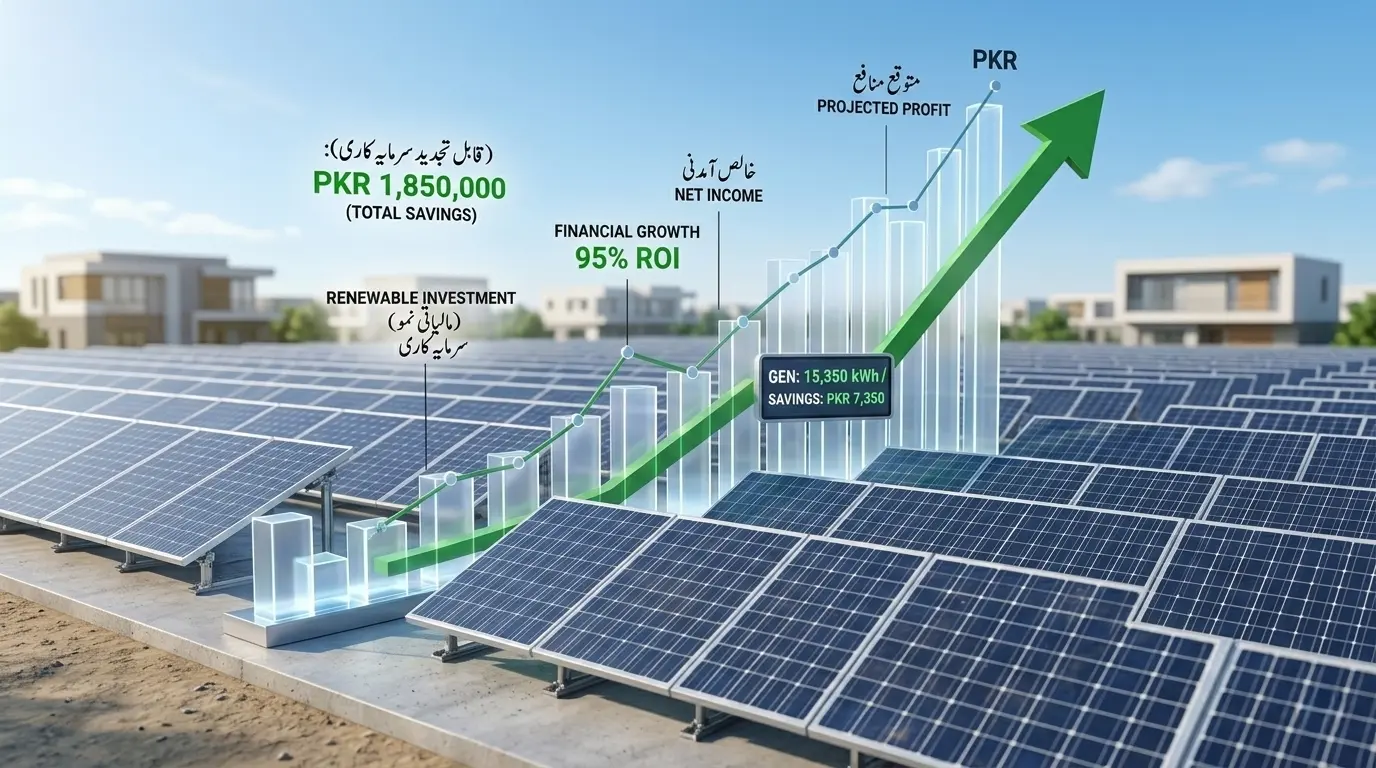
Thinking about solar panels for your home in Pakistan? The big question everyone asks is: when will this actually pay for itself? With electricity tariffs hitting PKR 65-75 per unit in 2026 and solar system prices dropping, the payback period has gotten much shorter than most people realize. We’re talking 2.5-4 years for a typical setup, not the 7-10 years it used to be.
Calculating your solar ROI (return on investment) isn’t complicated once you know what numbers to plug in. You need your current electricity bill from eBillPakistan showing your monthly consumption, the cost of a solar system sized for your needs, and Pakistan’s excellent sunshine hours. Let’s break down exactly how to calculate when your solar investment breaks even and starts putting money back in your pocket.
What Solar ROI Actually Means
ROI for solar panels is straightforward—it’s how long it takes for your electricity bill savings to equal what you paid for the solar system. After that payback period, every rupee you’re not paying to LESCO, IESCO, K-Electric, or your DISCO is pure profit for the next 20+ years.

The basic ROI formula:
Payback Period (in years) = Total Solar System Cost ÷ Annual Net Savings
Where Annual Net Savings = (Solar electricity produced × Grid tariff rate) – Annual maintenance costs – Net billing losses (if applicable)
Once you hit the payback year, the solar panels keep generating free electricity for another 20+ years. Solar panels typically last 25-30 years with only 0.5% annual degradation in output. So if your system pays for itself in 3 years, you get 22+ years of essentially free electricity afterward.
Key Factors Affecting Your Solar ROI in 2026
Several variables determine how quickly your solar investment pays for itself. Understanding these helps you make smart decisions when sizing and purchasing your system.
Your current electricity consumption and tariff rate:
Check your latest bill on eBillPakistan to see your monthly unit consumption and per-unit rate you’re paying. Higher consumption and higher tariff rates mean faster payback. If you’re paying PKR 70/unit for 600 units monthly, solar pays back much faster than someone paying PKR 40/unit for 200 units monthly.
Solar system cost per watt:
In 2026, solar panel prices in Pakistan average PKR 26-28 per watt for panels alone. Complete installed system costs including inverter, mounting, wiring, and labor run PKR 170-190 per watt for grid-tied systems, PKR 200-220 per watt for hybrid systems with battery backup.
Sunshine hours in your location:
Pakistan gets excellent sunlight for solar power. Peak sun hours vary by region:
- Lahore, Faisalabad, Gujranwala: 4.5-5 hours daily average
- Karachi, Hyderabad: 5-5.5 hours daily
- Multan, Bahawalpur, Southern Punjab: 5.5-6 hours daily
- Quetta, Balochistan: 5.5-6 hours daily
- Islamabad, Rawalpindi: 4-4.5 hours daily (slightly lower due to weather)
Net metering vs net billing policy:
If you export excess solar power back to the grid, what you get paid matters. Net metering (1:1 credit at full retail rate) gives better ROI than net billing where DISCOs buy your excess at PKR 11-15 per unit while you buy from them at PKR 65-70 per unit. This affects your calculation if you plan to export power.
System type—grid-tied vs hybrid:
Grid-tied systems are cheaper (no batteries) but don’t work during load shedding. Hybrid systems with battery backup cost PKR 200,000-400,000 more but provide power during outages, which has real value in Pakistan. The battery cost extends payback by 6-12 months but many consider it worth it.
Average Solar System Costs in Pakistan 2026
To calculate ROI, you need accurate system costs. Here’s what solar systems typically cost in Pakistan’s major cities in 2026 for quality components and professional installation.
| System Size | Suitable For (Monthly Units) | Grid-Tied Cost | Hybrid Cost (with battery) |
|---|---|---|---|
| 3kW System | 300-450 units | PKR 510,000 – 570,000 | PKR 710,000 – 820,000 |
| 5kW System | 500-750 units | PKR 850,000 – 950,000 | PKR 1,100,000 – 1,250,000 |
| 7kW System | 700-1,000 units | PKR 1,190,000 – 1,330,000 | PKR 1,500,000 – 1,700,000 |
| 10kW System | 1,000-1,500 units | PKR 1,700,000 – 1,900,000 | PKR 2,200,000 – 2,500,000 |
These costs include panels, inverter (or hybrid inverter + batteries for hybrid systems), mounting structure, wiring, safety equipment, installation labor, and basic warranty. Prices vary by brand, quality, and city. Karachi and Lahore tend to have more competitive pricing than smaller cities.
Cost breakdown for a typical 5kW hybrid system (PKR 1,150,000):
- Solar panels (5kW): PKR 140,000 (PKR 28/watt)
- Hybrid inverter: PKR 180,000
- Battery bank (10-15 kWh): PKR 350,000
- Mounting structure and hardware: PKR 100,000
- Wiring, safety equipment, accessories: PKR 80,000
- Installation labor and engineering: PKR 120,000
- Net metering setup: PKR 30,000
- Documentation and permits: PKR 20,000
- Company profit margin: PKR 130,000
How Much Electricity Will Your Solar System Generate
To calculate savings, you need to know how much electricity your solar system actually produces. This depends on system size and your location’s sunlight.
Daily generation formula:
Daily kWh = System size (kW) × Peak sun hours × System efficiency factor
System efficiency factor accounts for inverter losses, wiring losses, temperature effects, and dust. Use 0.80 (80%) as a realistic efficiency factor for Pakistan.
Example calculation for 5kW system in Lahore:
- System size: 5 kW
- Peak sun hours in Lahore: 5 hours average
- Efficiency factor: 0.80
- Daily generation: 5 × 5 × 0.80 = 20 kWh (units) per day
- Monthly generation: 20 × 30 = 600 units per month
- Annual generation: 600 × 12 = 7,200 units per year
| System Size | Daily Output (Lahore) | Monthly Output | Annual Output |
|---|---|---|---|
| 3kW | 12 units | 360 units | 4,320 units |
| 5kW | 20 units | 600 units | 7,200 units |
| 7kW | 28 units | 840 units | 10,080 units |
| 10kW | 40 units | 1,200 units | 14,400 units |
These are averages. Summer months generate more (May-August), winter months generate slightly less (November-February), but the annual average works out to these numbers.
Step-by-Step: Calculate Your Solar ROI
Let’s walk through a complete ROI calculation using a real example so you can plug in your own numbers.
Example household scenario:
- Location: Lahore
- Current monthly consumption: 600 units (check on eBillPakistan)
- Current per-unit rate: PKR 68 (average across slabs and FPA)
- Current monthly bill: PKR 40,800
- Considering: 5kW hybrid solar system
- System cost: PKR 1,150,000
Step 1: Calculate annual electricity cost without solar
600 units/month × PKR 68/unit × 12 months = PKR 489,600 per year
Step 2: Calculate annual solar generation
5kW × 5 sun hours × 0.80 efficiency × 365 days = 7,300 units per year
Step 3: Calculate gross annual savings
Since this household consumes 600 units monthly (7,200 annually) and solar generates 7,300 units annually, they can offset nearly 100% of their consumption.
Gross savings: 7,200 units × PKR 68/unit = PKR 489,600 (their entire current bill)
Step 4: Subtract annual maintenance costs
Solar systems need minimal maintenance: panel cleaning 2-4 times yearly, occasional inverter check, minor repairs.
Estimated annual maintenance: PKR 20,000
Net annual savings: PKR 489,600 – PKR 20,000 = PKR 469,600
Step 5: Calculate payback period
Payback period = PKR 1,150,000 ÷ PKR 469,600 = 2.45 years
So this 5kW hybrid system pays for itself in about 2.5 years. After that, the homeowner saves nearly PKR 470,000 per year (adjusted for degradation and inflation) for the next 22+ years.
“A PKR 1.15 million investment that pays for itself in 2.5 years and then generates PKR 470,000 annually for 22 more years is a 40%+ annual return. You won’t find that in any bank or investment fund in Pakistan.”

Real ROI Example: 5kW Hybrid System Over 25 Years
Let’s project the complete financial picture over the typical 25-year lifespan of solar panels, accounting for 0.5% annual degradation in panel output.
| Year | System Efficiency | Annual Savings (PKR) | Cumulative Savings (PKR) | Net Profit (PKR) |
|---|---|---|---|---|
| 1 | 100% | 469,600 | 469,600 | -680,400 |
| 2 | 99.5% | 467,252 | 936,852 | -213,148 |
| 3 | 99% | 464,904 | 1,401,756 | +251,756 |
| 5 | 98% | 460,208 | 2,323,620 | +1,173,620 |
| 10 | 95.5% | 448,468 | 4,572,040 | +3,422,040 |
| 15 | 93% | 436,728 | 6,779,280 | +5,629,280 |
| 20 | 90.5% | 424,988 | 8,945,340 | +7,795,340 |
| 25 | 88% | 413,248 | 11,070,220 | +9,920,220 |
25-year total return:
- Initial investment: PKR 1,150,000
- Total savings over 25 years: PKR 11,070,220
- Net profit: PKR 9,920,220
- Return on investment: 862% over 25 years
- Average annual return: 34.5%
This calculation assumes electricity tariffs stay constant at PKR 68/unit. In reality, DISCO tariffs in Pakistan have increased 10-15% annually. If tariffs continue rising, your actual savings will be significantly higher than these conservative projections.
How to Calculate Your Personal Solar ROI
Ready to calculate your own numbers? Here’s the formula customized for Pakistan with spaces to plug in your specific details.
Information you need:
- Your monthly electricity consumption in units (get from eBillPakistan)
- Your average per-unit cost (total bill ÷ units consumed)
- Solar system size you’re considering (kW)
- Total installed cost quote from solar company
- Your location’s average peak sun hours (4-6 hours for most of Pakistan)
Your calculation worksheet:
A. Annual electricity cost without solar:
Monthly units: _____ × Per-unit rate: PKR _____ × 12 months = PKR _____
B. Annual solar generation:
System size: _____ kW × Peak sun hours: _____ × 0.80 efficiency × 365 days = _____ units
C. Gross annual savings:
Solar units generated: _____ × Per-unit rate: PKR _____ = PKR _____
(If you generate more than you consume and export at lower net billing rates, adjust this calculation accordingly)
D. Net annual savings:
Gross savings: PKR _____ – Maintenance: PKR 20,000 = PKR _____
E. Payback period:
Total system cost: PKR _____ ÷ Net annual savings: PKR _____ = _____ years
F. 25-year return:
Net annual savings: PKR _____ × 22 years (accounting for degradation) = PKR _____
Minus initial investment: PKR _____ = Net profit: PKR _____
Factors That Can Speed Up Your ROI
Several strategies can reduce your payback period below the average 2.5-4 years.
Size your system perfectly to your consumption:
Check your eBillPakistan history over 6-12 months. Don’t oversize based on one high summer month or undersize based on low winter consumption. Match system size to your average annual consumption. Oversizing means wasting money on panels whose power you export at low rates. Undersizing means you still pay DISCO bills unnecessarily.
Take advantage of CM Punjab free solar scheme if eligible:
If you’re in Punjab and consume under 200 units monthly, you might qualify for completely free solar panels under the Roshan Gharana program. That’s instant infinite ROI since you pay nothing. Check eligibility and register immediately if you qualify.
Get multiple quotes and negotiate:
Solar prices in Pakistan dropped 10-15% in 2026 due to increased competition and lower panel import costs. Get quotes from at least 3-4 companies. Don’t just go with the cheapest—verify component quality and warranties—but use competing quotes to negotiate better pricing.
Consider grid-tied if you have stable power:
If your area has minimal load shedding or you can tolerate outages, grid-tied systems without batteries cost PKR 200,000-400,000 less. This shorter payback by 6-12 months. You can always add batteries later if needed.
Install during off-peak season:
Solar companies are busiest in April-June when people panic about summer bills. Negotiate better prices in November-February when demand is lower and installers have more capacity.
Optimize your consumption patterns:
Run heavy appliances like washing machines, water pumps, and irons during peak solar generation hours (10 AM – 3 PM). This maximizes self-consumption and minimizes reliance on the grid or battery, getting more value from every solar unit generated.
Net Metering vs Net Billing: Impact on ROI
How your DISCO handles excess solar power significantly affects ROI, especially if you generate more than you consume.
Net Metering (older policy, being phased out):
- You get 1:1 credit for excess power exported to grid
- If you export at PKR 68/unit daytime, you can use that credit for PKR 68/unit nighttime
- Your meter runs backward when exporting
- Excellent ROI since you effectively get retail rates for your solar power
- Most DISCOs stopped offering this for new connections in 2024-2025
Net Billing (current policy for most new connections):
- DISCO buys your excess power at wholesale rates (PKR 11-15/unit)
- You buy from DISCO at retail rates (PKR 65-75/unit)
- Massive difference means exporting power gives poor returns
- Slows ROI if you generate significantly more than you consume
- Makes hybrid systems with batteries more attractive—store excess rather than export
ROI comparison example: 5kW system generating 7,200 units, consuming 6,000 units
| Scenario | Self-Consumed | Exported | Annual Savings | Payback Period |
|---|---|---|---|---|
| Net Metering | 6,000 units × PKR 68 | 1,200 units × PKR 68 | PKR 489,600 | 2.35 years |
| Net Billing | 6,000 units × PKR 68 | 1,200 units × PKR 12 | PKR 422,400 | 2.72 years |
| Hybrid (battery storage) | 6,800 units × PKR 68 | 400 units × PKR 12 | PKR 467,200 | 2.46 years |
Under net billing, hybrid systems with batteries become more attractive despite higher cost because you use more of your solar generation at retail value rather than exporting at wholesale prices.

Common Mistakes That Hurt Solar ROI
Avoid these errors that extend payback periods or reduce long-term returns.
Oversizing your system hoping for more income from exports:
Under net billing, exporting gives terrible returns at PKR 11-15/unit. Size your system to match consumption, not to become a power generator. An oversized system costs more upfront and recovers slowly through low-value exports.
Choosing cheapest components without checking quality:
Low-quality panels degrade faster than 0.5% annually, reducing long-term returns. Cheap inverters fail earlier, requiring replacement costs. The few thousand rupees saved upfront cost tens of thousands in lost generation and repair expenses over 25 years.
Not factoring in your location’s actual sun hours:
Using 6 sun hours for calculations when you’re in Islamabad (4.5 hours) inflates expected generation by 25%, making ROI projections unrealistic. Be honest about your location’s sunshine to avoid disappointment.
Ignoring maintenance completely in calculations:
Even though solar maintenance is minimal, it exists. Panels need cleaning 2-4 times yearly (more in dusty areas). Inverters occasionally need servicing. Budget PKR 15,000-25,000 annually or your actual returns will fall short of projections.
Not checking your actual bill on eBillPakistan first:
People estimate consumption from memory or guess at tariff rates. Check eBillPakistan for accurate numbers. Your consumption might be lower than you think (better ROI since you need a smaller system) or your tariff might be higher than assumed (better ROI since savings are larger).
“I’ve seen people buy 10kW systems for houses using 500 units monthly because they wanted to ‘make money selling power.’ Under net billing, they’re exporting 50% of generation at PKR 12/unit when they paid PKR 180/watt to generate it. That’s terrible ROI. Size systems to consumption, not dreams of becoming a power company.”
How Rising Tariffs Improve Your Solar ROI
One factor that makes solar in Pakistan incredibly attractive is electricity tariff trajectory. DISCO tariffs have increased 10-15% annually for the past decade, with no sign of reversal.
What rising tariffs mean for solar ROI:
When you calculate payback using today’s PKR 68/unit tariff, you’re being conservative. In reality, your savings grow each year as DISCO rates increase while your solar generation cost stays fixed (already paid upfront).
Example with 10% annual tariff increases:
| Year | DISCO Tariff (PKR/unit) | Annual Savings (7,200 units) | Cumulative Savings |
|---|---|---|---|
| 1 | 68 | 489,600 | 489,600 |
| 2 | 75 | 540,000 | 1,029,600 |
| 3 | 82 | 590,400 | 1,620,000 |
| 5 | 98 | 705,600 | 3,088,800 |
| 10 | 158 | 1,137,600 | 8,870,400 |
If you calculate ROI at fixed rates, a 5kW system pays back in 2.5 years. If you factor in realistic 10% annual tariff increases, actual payback is closer to 2 years, and 10-year returns double.
This is why solar is one of the best investments in Pakistan right now—you’re hedging against inevitable electricity price increases while locking in your generation cost today.
Solar ROI in Pakistan in 2026 is excellent—2.5-4 year payback periods for properly sized systems, then 20+ years of nearly free electricity. The math is straightforward once you have accurate numbers from eBillPakistan showing your actual consumption and tariff rates.
Calculate your personal ROI using the formulas and worksheet provided. Size your system to match your consumption, get multiple quotes, choose quality components with good warranties, and factor in realistic maintenance costs. Under these conditions, solar delivers 30-40% annual returns over its lifetime—far better than any bank deposit, mutual fund, or property investment in Pakistan.
The combination of high electricity tariffs (PKR 65-75/unit), excellent sunshine (4-6 hours daily), and lower solar equipment costs (PKR 170-190/watt installed) creates perfect conditions for solar investment. Add inevitably rising DISCO tariffs into the equation, and waiting costs you money every month you delay.

Farhan Shafique is a Pakistan-based researcher and content writer specializing in electricity billing systems and public utility services. He has spent years studying billing structures, tariff calculations, and consumer rights to help people better understand their monthly bills. Through detailed guides and step-by-step explanations, he aims to simplify complex utility processes for everyday users.