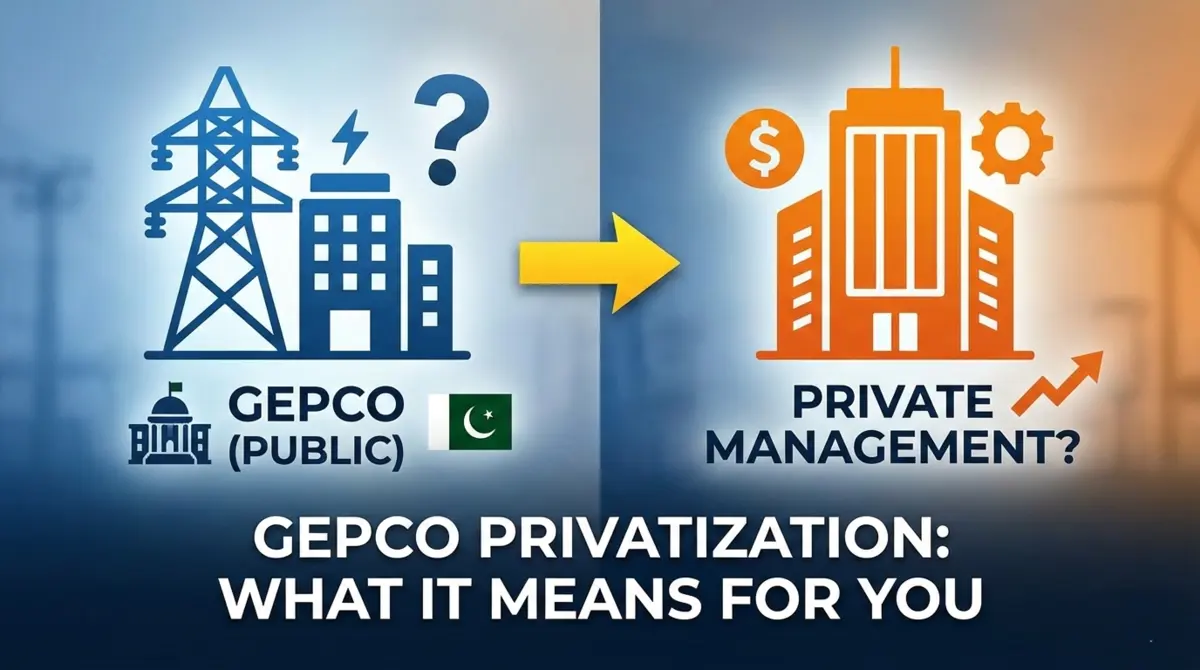
The potential privatization of Gujranwala Electric Power Company (GEPCO) has become one of the most discussed topics among electricity consumers across the regions it serves, including Gujranwala, Sialkot, Narowal, Hafizabad, and Mandi Bahauddin. As the Government of Pakistan pursues structural reforms in the power sector under international financial institution recommendations, GEPCO stands among several distribution companies being considered for transfer to private management.
Current Status of GEPCO Privatization Efforts
The privatization of distribution companies like GEPCO forms part of Pakistan’s broader power sector reform agenda, which gained momentum following agreements with the International Monetary Fund and other lending institutions that identified inefficiencies in state-owned utilities as critical economic challenges. As of early 2025, GEPCO privatization remains in preliminary planning stages, with the government conducting feasibility studies, asset valuations, and stakeholder consultations to determine the optimal approach for transferring management or ownership to private entities. The Privatisation Commission of Pakistan has included GEPCO on its active consideration list alongside other distribution companies, though no definitive timeline for transaction completion has been publicly announced.

Understanding Pakistan’s Power Sector Privatization Framework
The privatization framework distinguishes between different models of private sector participation, ranging from management contracts where private companies operate the utility while government retains ownership, to long-term leases, strategic partnerships involving partial private ownership, and complete divestment where private investors acquire full ownership of assets and operations. Each model has different implications for pricing, service quality, and regulatory oversight.
Pakistan’s previous experiences with power sector privatization provide instructive examples, including the Karachi Electric Supply Company (now K-Electric) which transitioned to private ownership in 2005 and operates under a special regulatory arrangement that differs from other distribution companies. The legal framework also includes constitutional protections and regulatory requirements that prevent arbitrary tariff increases, mandate public hearings before major rate changes, and establish consumer grievance mechanisms that continue regardless of ownership structure.
Historical Evidence: What Happened After K-Electric Privatization?
Examining K-Electric’s privatization provides the most relevant Pakistani case study for understanding potential outcomes of GEPCO’s transition to private ownership, though important contextual differences must be acknowledged. K-Electric, which serves Karachi and surrounding areas, was privatized in 2005 when the government sold its controlling stake to private investors. The post-privatization period saw mixed results that offer both encouraging signs and cautionary lessons. Initially, K-Electric invested significantly in infrastructure upgrades, reducing technical losses and improving service reliability in many areas, particularly in commercial zones and upscale residential neighborhoods.

Factors That Actually Determine Your Electricity Bill
Understanding what components comprise your electricity bill clarifies which factors privatization might influence and which remain largely independent of ownership structure. Your GEPCO electricity bill consists of several distinct charges that respond to different economic and operational variables:
- Energy Purchase Cost: The largest component, representing what GEPCO pays to purchase electricity from generation companies and the national grid, remains determined by fuel costs, generation mix, and power purchase agreements that exist independently of distribution company ownership
- Transmission Charges: Fees for moving electricity through the national transmission network, set by NEPRA based on transmission company costs, remain unaffected by GEPCO’s ownership status
- Distribution Margin: The portion covering GEPCO’s operational costs and allowed profit, this component could potentially be influenced by privatization depending on efficiency improvements or cost increases under new management
- System Losses: Technical and non-technical losses including theft and billing inefficiencies, where private management might reduce losses through better monitoring, potentially stabilizing or reducing this cost component
- Government Taxes and Levies: Sales tax, income tax, and other government-imposed charges that remain policy decisions independent of GEPCO ownership
- Fuel Price Adjustments: Monthly variations reflecting changes in international fuel costs, applied uniformly across all distribution companies regardless of ownership
- Capacity Payments: Charges to maintain generation capacity availability, part of the broader power sector structure unrelated to distribution company ownership
This breakdown reveals that privatization directly impacts only the distribution margin and potentially the losses component of your bill, while the majority of charges—particularly energy purchase costs that typically comprise 60-70% of total bills—remain determined by factors completely separate from whether GEPCO operates under government or private ownership.
Potential Positive Impacts on Consumer Billing
While concerns about tariff increases dominate privatization discussions, several mechanisms could potentially stabilize or even reduce certain cost components if GEPCO privatization is implemented effectively with proper regulatory oversight. Private management often brings technological expertise and investment capacity that government-operated utilities struggle to access due to fiscal constraints and bureaucratic limitations. Advanced metering infrastructure, automated billing systems, and sophisticated loss detection technology could reduce non-technical losses including electricity theft and billing errors that currently inflate costs for honest paying customers who effectively subsidize these losses through higher tariffs.
International experience shows that well-regulated private utilities in developing countries have sometimes achieved loss reduction of 5-10 percentage points within several years of takeover, which could translate to meaningful bill reductions for consumers if similar improvements materialized in GEPCO’s service area.

NEPRA’s Role in Protecting Consumers Post-Privatization
NEPRA serves as the primary institutional safeguard for consumer interests regardless of GEPCO’s ownership, with its regulatory powers remaining intact after privatization. It controls tariff determination, preventing arbitrary rate increases by requiring detailed, publicly reviewed tariff petitions and conducting transparent hearings where consumers can raise objections. NEPRA also enforces service quality and performance standards, imposes fines for non-compliance, and attaches binding license conditions on service levels, investment, and consumer protection.
Its framework allows periodic tariff adjustments to manage fuel and currency fluctuations while avoiding undue losses or windfall profits. Consumer complaint and dispute mechanisms further enable challenges to billing and service issues. However, effective consumer protection depends on NEPRA’s funding, technical capacity, independence, and enforcement strength, which may need reinforcement prior to privatization.
Comparing Privatization Models and Their Impact on Bills
Different privatization approaches carry distinct implications for electricity tariffs and service quality, making the specific structure of GEPCO’s eventual privatization critically important to outcomes consumers experience. The following table compares major privatization models under consideration:
| Privatization Model | Ownership Structure | Likely Tariff Impact | Service Quality Expectation | Consumer Protection Level |
|---|---|---|---|---|
| Management Contract | Government retains ownership; private company operates for fee | Minimal initial impact; depends on efficiency improvements | Moderate improvement if contract includes performance incentives | High – government maintains oversight responsibility |
| Long-term Lease | Government owns assets; private company leases and operates | Moderate increase possible to cover lease payments and investments | Potentially significant improvement with proper lease terms | Moderate – depends on lease agreement consumer protections |
| Strategic Partnership | Joint ownership between government and private investors | Variable; depends on partnership agreement and investment requirements | Improvement likely with private sector expertise and government oversight balance | Moderate to High – shared governance provides checks |
| Full Divestment | Complete sale to private owners | Highest risk of increases; depends heavily on regulatory strength | Could be highest if investor brings capital and expertise; could be lowest if profit extraction prioritized | Variable – entirely dependent on NEPRA regulatory effectiveness |
The government’s selection among these models should consider not only financial objectives like maximizing sale proceeds or reducing fiscal burden, but also consumer protection implications, service quality expectations, and regulatory capacity to oversee private operations effectively. International best practices suggest that developing countries with emerging regulatory institutions often achieve better outcomes through gradual approaches like management contracts or strategic partnerships that transfer operational expertise while maintaining government ownership stakes and oversight mechanisms, compared to rapid full divestment that places excessive burden on untested regulatory capacity.
Regional Economic Factors Affecting Post-Privatization Tariffs
GEPCO’s service territory encompasses economically diverse regions with varying characteristics that influence both the attractiveness of privatization to potential investors and the likely tariff impacts on different consumer categories. The industrial concentration in Sialkot, particularly the sports goods, surgical instruments, and leather industries, creates a substantial commercial and industrial consumer base that generates higher revenue per customer compared to residential consumers, potentially making GEPCO more attractive to private investors than distribution companies serving primarily residential or agricultural areas.
Government Policy Objectives and Consumer Impact
Understanding the government’s stated objectives for power sector privatization provides context for evaluating likely consumer impacts and helps distinguish between outcomes driven by policy design versus implementation failures. The government’s primary motivations include reducing fiscal burden from perpetual bailouts of loss-making distribution companies, improving operational efficiency to reduce system losses that currently exceed 15-20% in many areas, attracting private capital for infrastructure investment that government budgets cannot finance, breaking the circular debt cycle where distribution companies’ inability to collect revenues and operational inefficiencies create payment defaults throughout the power sector, and meeting conditions imposed by international financial institutions for continued lending support. These objectives don’t inherently conflict with consumer interests; in fact, reducing losses and improving efficiency should theoretically benefit consumers through lower tariffs than would exist if current inefficiencies continued.
What Consumers Can Do to Protect Their Interests
While GEPCO privatization decisions ultimately rest with government authorities and regulatory bodies, consumers can take several proactive steps to protect their interests and ensure their concerns receive appropriate consideration throughout the privatization process. Individual and collective action strategies include:
- Stay Informed: Monitor official announcements from the Privatisation Commission, Ministry of Energy, and NEPRA regarding GEPCO privatization plans, timelines, and proposed structures through their websites and public notices
- Participate in Public Consultations: Attend public hearings that NEPRA conducts before major regulatory decisions, where consumers can formally present concerns about proposed tariff changes or service quality standards
- Document Current Service Levels: Keep records of your current electricity bills, outage frequency and duration, and service quality to establish baseline metrics for evaluating whether privatization improves or degrades service
- Join Consumer Advocacy Groups: Participate in or support consumer protection organizations that can engage with regulators and policymakers more effectively than individual consumers
- Submit Formal Comments: When NEPRA or the Privatisation Commission seeks public input on privatization proposals, submit written comments highlighting specific consumer concerns and recommendations
- Engage Local Representatives: Contact elected officials including National Assembly members and provincial assembly representatives from GEPCO service areas to ensure political leadership understands constituent concerns about privatization
- Monitor Post-Privatization Performance: If privatization proceeds, systematically track whether promised improvements materialize and whether tariff changes align with service quality changes, reporting discrepancies through official complaint channels
- Understand Your Rights: Familiarize yourself with consumer protection provisions in NEPRA regulations and the legal framework governing electricity distribution to know when operators violate your rights
- Use Media Strategically: Legitimate consumer concerns raised through responsible media channels can influence policymakers and regulators, though avoid spreading unverified information that creates unnecessary panic
Consumer engagement proves most effective when based on factual information rather than speculation, when focused on specific, measurable concerns rather than generalized opposition to change, and when offering constructive suggestions for protecting consumer interests rather than simply resisting any privatization under all circumstances.
Comparative Analysis: Government vs. Private Utility Performance
Empirical evidence from Pakistan and similar developing countries provides a nuanced picture of how government-owned and privately-operated utilities compare on metrics that matter to consumers, including pricing, service reliability, customer service quality, and investment in infrastructure. The following comparative analysis draws on available data:
“International experience shows no automatic superiority of either public or private ownership in utility performance. Rather, outcomes depend critically on regulatory quality, management competence, investment levels, and accountability mechanisms regardless of ownership structure. Well-managed public utilities can outperform poorly regulated private companies, while effectively regulated private utilities can surpass inefficient government operations.”
In Pakistan, government-owned DISCOs like GEPCO struggle with political interference, funding and procurement constraints, weak commercial discipline, and talent retention, while K-Electric’s privatized model shows mixed results—significant loss reduction and infrastructure investment alongside tariff, service, and equity concerns—demonstrating that privatization outcomes depend more on implementation quality, regulatory strength, and binding performance commitments than on ownership alone.
Subsidy Structure and Vulnerable Consumer Protection
A key concern in GEPCO privatization is whether electricity subsidies for low-consumption residential and agricultural users would continue, as private operators seeking cost recovery and profits may resist selling below cost unless clearly structured government compensation, regulatory mandates, or targeted consumer support mechanisms are contractually enforced in advance to prevent subsidy withdrawal and sharp bill increases for vulnerable groups.
Timeline Expectations and Transition Planning
Understanding realistic timelines for GEPCO privatization is essential for consumers because the process typically spans 18–36 months or longer in Pakistan, moving through feasibility studies, asset valuation, legal and regulatory reviews, stakeholder consultations, decisions on privatization structure, detailed transaction preparation, financial restructuring, competitive investor bidding, bid evaluation, contract finalization, regulatory approvals, financing arrangements, and transition planning—often with delays—during which consumer engagement is possible but uncertainty must be carefully managed to avoid service disruptions, billing confusion, or accountability gaps.
Expert Opinions and Stakeholder Perspectives
Diverse expert and stakeholder views on GEPCO privatization range from economic policy experts who see private efficiency, capital, and technology improving performance and long-term outcomes, to consumer groups and labor unions warning that profit-driven ownership could raise tariffs, weaken service in less profitable areas, and threaten jobs, while energy analysts and NEPRA officials stress that outcomes hinge on strong regulatory frameworks and implementation details rather than ownership alone, and local businesses remain divided between hopes for better reliability and fears of higher costs.
Preparing for Potential Tariff Changes
Regardless of whether GEPCO privatization raises, lowers, or leaves tariffs unchanged, consumers can manage electricity costs by improving energy efficiency, understanding and adjusting consumption patterns, adopting load management strategies, building small financial buffers for utility bills, exploring feasible alternative energy options like solar, staying informed about tariff structures and billing rights, and engaging in community-level efficiency initiatives to reduce financial impact and strengthen consumer resilience against potential changes.
Frequently Asked Questions About GEPCO Privatization and Bills
Addressing common questions helps clarify misconceptions and provide specific information consumers need to understand privatization implications:
Will my electricity bill definitely increase if GEPCO is privatized?
Not necessarily. Bill changes depend on multiple factors including how efficiently the private operator performs, what investments they make, how effectively NEPRA regulates pricing, and broader economic conditions affecting fuel costs and exchange rates that impact all distribution companies regardless of ownership. Some tariff components could potentially decrease if efficiency improvements reduce losses and operational costs.
Can I choose a different electricity supplier if I don’t like the private company operating GEPCO?
Currently no. Pakistan’s electricity distribution system operates as territorial monopolies where single companies serve defined geographic areas, meaning GEPCO consumers cannot switch to alternative suppliers. This monopoly structure makes effective regulatory oversight critical since consumers lack the market-based protection that competition would provide.
What happens to subsidies for low-income consumers and agricultural users?
This remains subject to how privatization is structured. Ideally, subsidy mechanisms would continue with government directly compensating the private operator for subsidized rates, though this requires specific contractual and regulatory provisions. Advocates should push for explicit subsidy protection in any privatization agreement.
Will service quality improve after privatization?
Potentially, but not automatically. Service improvements depend on whether the private operator invests in infrastructure, implements better maintenance practices, and faces effective regulatory enforcement of service quality standards. International experience shows varied outcomes ranging from significant improvements to deterioration depending on implementation specifics.
How long will the privatization process take?
Based on standard processes, realistically 18-36 months from formal announcement to operational transfer, though Pakistan’s privatization history shows frequent delays. The extended timeline provides opportunities for consumer engagement in the process.
Who regulates the private company to prevent unfair pricing?
NEPRA maintains regulatory authority over electricity tariffs and service quality regardless of ownership. However, regulatory effectiveness depends on NEPRA having adequate resources, technical capacity, and political independence to enforce consumer protections against powerful private entities.
What happens to current GEPCO employees?
Employment implications depend on privatization terms negotiated between government and purchasers. Often privatization agreements include provisions protecting existing employees for specified periods, though longer-term employment levels might change as private operators pursue efficiency improvements.
Conclusion and Key Takeaways
Whether GEPCO privatization will raise electricity bills cannot be predicted with certainty because outcomes depend on privatization design, regulatory strength and enforcement, operational efficiency, investment, loss reduction, and broader economic factors, requiring a balanced approach that avoids panic or complacency, strengthens NEPRA’s capacity, embeds enforceable tariff and service protections, preserves subsidies for vulnerable consumers through government mechanisms, ensures transparent monitoring and dispute resolution, favors gradual privatization models, and encourages informed, organized, and energy-efficient consumer engagement so the transition serves public interest rather than merely shifting a public monopoly into private hands.

Farhan Shafique is a Pakistan-based researcher and content writer specializing in electricity billing systems and public utility services. He has spent years studying billing structures, tariff calculations, and consumer rights to help people better understand their monthly bills. Through detailed guides and step-by-step explanations, he aims to simplify complex utility processes for everyday users.