
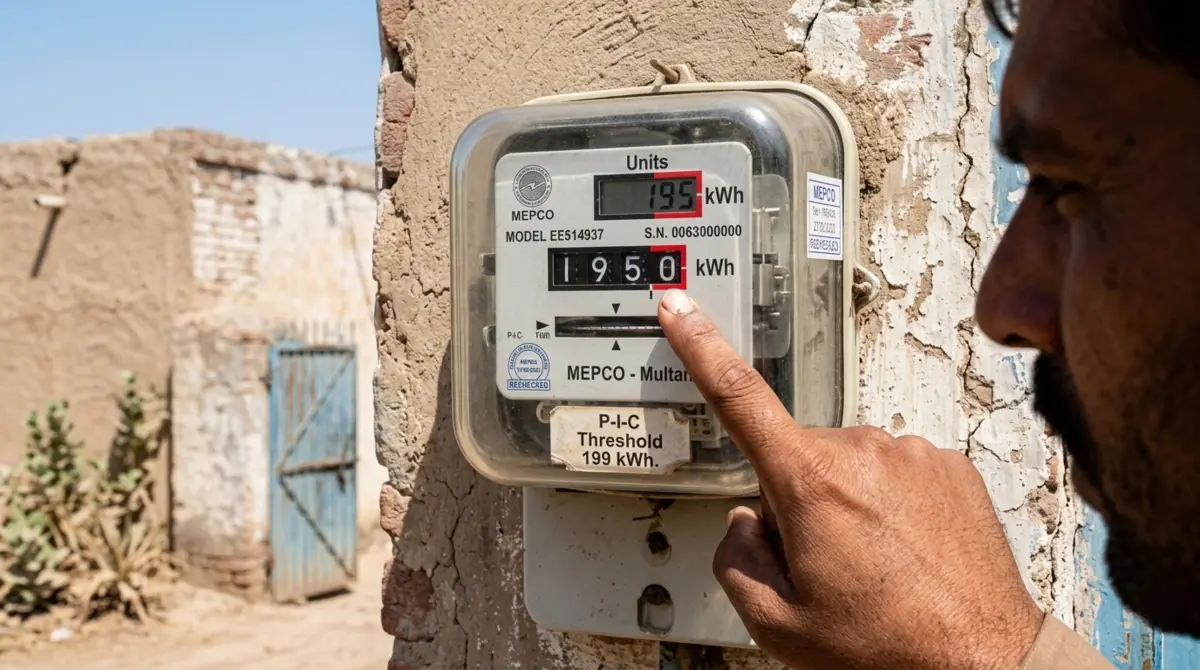
If you’re getting electricity from MEPCO in Multan, Bahawalpur, D.G. Khan, or Rahim Yar Khan, understanding the difference between protected and unprotected consumer categories can literally save you thousands of rupees every month. The 2026 tariff structure has widened the gap between these two categories even further, and most people don’t realize which bracket they fall into until they see a shockingly high bill.
MEPCO (Multan Electric Power Company) serves over 4.5 million consumers across southern Punjab. The protected vs. unprotected classification determines your per-unit electricity rate, and crossing that threshold even by a single unit can spike your entire bill by 40-60%. Let’s break down exactly how these rates work in 2026 and what you can do to stay in the cheaper category.

What Changed in MEPCO Rates for 2026
NEPRA (National Electric Power Regulatory Authority) approved new tariff rates for MEPCO effective January 2026. The basic structure stays the same—protected consumers get subsidized rates while unprotected consumers pay market rates—but the actual per-unit charges went up across the board.
Here’s what actually changed:
- Protected consumer rates increased by PKR 2-3 per unit on average
- Unprotected consumer rates jumped by PKR 4-6 per unit
- The consumption threshold for protected status stayed at 200 units per month
- Fuel Price Adjustment (FPA) now applies differently to both categories
- Quarterly tariff adjustments became more frequent
The biggest shock for MEPCO consumers in Multan, Bahawalpur, D.G. Khan, and Rahim Yar Khan came from the cumulative effect. When you add base rates plus FPA plus taxes, protected consumers now pay around PKR 18-22 per unit while unprotected consumers pay PKR 35-45 per unit for the same electricity.
Protected vs. Unprotected: What’s the Actual Difference
The Pakistani government subsidizes electricity for lower consumption households through the protected consumer category. The idea is that people using less electricity are probably lower or middle income families who need financial relief. If you consume more than 200 units monthly, the government assumes you can afford market rates.
“We see families in Multan panic when their bill suddenly doubles just because they used 205 units instead of 195. They don’t understand that crossing 200 units removes the entire subsidy, not just for the extra 5 units, but for all 205 units.” — MEPCO Customer Service Representative, Multan
Protected Consumer Status:
- Monthly consumption up to 200 units
- Receives government subsidy on per-unit rates
- Lower slab rates apply progressively
- Eligible for additional relief programs during summer
- FPA charges are usually capped or reduced
Unprotected Consumer Status:
- Monthly consumption exceeds 200 units
- Pays full market rate with no subsidy
- Higher slab rates for all consumption
- No government relief regardless of season
- Full FPA charges apply without caps

MEPCO Unit Rates 2026: Complete Breakdown
Here are the actual per-unit rates you’ll pay on your MEPCO bill in 2026. These are base rates before adding FPA, GST, and other charges.
Protected Consumer Rates (Up to 200 Units)
| Consumption Slab | Rate per Unit (PKR) | Example Bill (Base Rate Only) |
|---|---|---|
| 0-50 units | PKR 4.50 | 50 units = PKR 225 |
| 51-100 units | PKR 7.50 | 100 units = PKR 600 (PKR 225 + PKR 375) |
| 101-200 units | PKR 11.50 | 200 units = PKR 1,750 (PKR 600 + PKR 1,150) |
Unprotected Consumer Rates (Above 200 Units)
| Consumption Slab | Rate per Unit (PKR) | Example Bill (Base Rate Only) |
|---|---|---|
| 201-300 units | PKR 22.50 | 250 units = PKR 5,625 |
| 301-400 units | PKR 26.00 | 350 units = PKR 8,250 + previous slabs |
| 401-500 units | PKR 28.50 | 450 units = PKR 11,100 + previous slabs |
| 501-700 units | PKR 31.00 | 600 units = PKR 17,400 + previous slabs |
| Above 700 units | PKR 35.00 | 800 units = PKR 26,900 + previous slabs |
These are base rates. Your actual MEPCO bill includes FPA (usually PKR 3-7 per unit), GST at 18%, extra charges, and sometimes a TV fee. A protected consumer using 180 units pays around PKR 3,500-4,200 total. An unprotected consumer using 220 units pays around PKR 7,500-9,000 total.
Real Bill Comparison: Protected vs. Unprotected
Let’s look at actual bills from MEPCO consumers in Multan and Bahawalpur to see the real-world difference. These examples include all charges—base rate, FPA, GST, and other fees.
| Monthly Units | Consumer Status | Base Charges | FPA + Taxes | Total Bill |
|---|---|---|---|---|
| 150 units | Protected | PKR 1,200 | PKR 1,450 | PKR 2,650 |
| 195 units | Protected | PKR 1,680 | PKR 2,100 | PKR 3,780 |
| 205 units | Unprotected | PKR 4,615 | PKR 3,200 | PKR 7,815 |
| 300 units | Unprotected | PKR 6,750 | PKR 4,850 | PKR 11,600 |
| 500 units | Unprotected | PKR 13,200 | PKR 8,900 | PKR 22,100 |
Notice what happens between 195 and 205 units. Just 10 extra units more than doubles your bill from PKR 3,780 to PKR 7,815. That’s because you lose protected status and all 205 units get charged at unprotected rates, not just the 5 units over 200.
“Every summer we get hundreds of complaints from Bahawalpur and D.G. Khan where people used one extra AC unit or left lights on for a few more hours, crossed 200 units, and their bill jumped from PKR 3,500 to PKR 8,000. They think it’s a billing error until we explain the protected threshold.”
How to Check Your MEPCO Bill and Consumer Status
You can easily check your current MEPCO bill, see whether you’re classified as protected or unprotected, and review your consumption history through eBillPakistan. This helps you track if you’re approaching the 200-unit threshold.
Checking your bill regularly on eBillPakistan helps you catch consumption spikes early. If you see yourself hitting 180-190 units mid-month, you know to be extra careful about electricity use for the rest of the billing cycle.
Why MEPCO Rates Are Higher Than Other DISCOs
People in Multan, Bahawalpur, D.G. Khan, and Rahim Yar Khan often complain that MEPCO rates feel higher than what their relatives in Lahore (LESCO) or Islamabad (IESCO) pay. There’s some truth to this perception, though the official tariff structure is similar across all DISCOs.
Factors making MEPCO bills feel higher:
- Extreme summer temperatures: Southern Punjab sees 45-50°C regularly, forcing higher AC usage than central or northern regions
- Longer summer season: Multan and Bahawalpur areas need cooling from April to October, not just June-August
- Higher line losses: MEPCO’s transmission and distribution losses are among the highest in Pakistan, and these costs get passed to consumers
- Infrastructure limitations: Older grid infrastructure means more technical losses and higher operational costs
- Load shedding impact: When power comes back after outages, appliances like fridges and ACs draw more power initially
A household in Multan using AC for 12 hours daily in June will easily hit 400-500 units monthly. The same household in Islamabad might only need AC for 6-8 hours and consume 250-300 units. So even at identical tariff rates, MEPCO consumers end up with higher bills due to climate and usage patterns.
Summer Months: When Everyone Loses Protected Status
May through September is when most MEPCO consumers in Multan, Bahawalpur, D.G. Khan, and Rahim Yar Khan districts suddenly become unprotected consumers. Summer heat makes it nearly impossible to stay under 200 units if you have air conditioning.
Let’s look at typical consumption patterns:
| Appliance Usage | Daily Consumption | Monthly Units |
|---|---|---|
| 1 Ton AC (8 hours/day) | 9-12 units | 270-360 units |
| Refrigerator (24/7) | 2-3 units | 60-90 units |
| 3 Ceiling Fans (12 hours) | 1 unit | 30 units |
| LED Lights (6 hours) | 0.3 units | 9 units |
| TV + Misc (4 hours) | 0.5 units | 15 units |
| Total | 13-17 units/day | 384-504 units/month |
Just running one AC for 8 hours daily puts you solidly in unprotected territory. This is why summer MEPCO bills in southern Punjab shock so many families who managed to stay protected during winter months.
Strategies to Stay in Protected Category
Staying under 200 units requires discipline, especially during Multan and Bahawalpur’s brutal summers. But if you can manage it, you’ll save PKR 4,000-6,000 monthly compared to crossing into unprotected status.
Practical tips from MEPCO consumers who stay protected:
- Set AC to 26-27°C instead of 18-20°C: Higher temperature settings cut AC consumption by 30-40%
- Use AC only in one room: Cool the bedroom at night, use fans during the day in other rooms
- Run AC with timer: Set it to turn off after you fall asleep instead of running all night
- Improve insulation: Thermal curtains, weather stripping, and ceiling insulation reduce AC load significantly
- Switch to LED lighting completely: Saves 10-15 units monthly compared to old bulbs
- Unplug devices not in use: Standby power from TVs, chargers, and appliances adds up
- Time high-consumption activities: Iron clothes, use washing machine, and run water pump during off-peak hours
- Monitor consumption weekly: Check your meter reading every week, calculate daily average, and adjust usage if approaching 200 units
Some families in D.G. Khan and Rahim Yar Khan split their home load across two separate meters if possible, keeping each under 200 units. While this requires two connections and double the fixed charges, the per-unit savings can still make it worthwhile for larger households.
What If You Can’t Stay Under 200 Units
For many households in Multan and Bahawalpur, staying protected simply isn’t realistic. If you have a family of 6+ people, live in a poorly insulated house, or work from home requiring AC all day, you’ll exceed 200 units no matter how careful you are.
Once you accept you’ll be unprotected, focus on minimizing total consumption rather than stressing about the 200-unit threshold:
- Track consumption targets: If you’re going to hit 300 units anyway, might as well aim for 220 rather than 280
- Invest in energy-efficient appliances: Inverter ACs use 30-40% less electricity than old models
- Consider solar panels: Net metering can significantly reduce your MEPCO bill if you’re consistently hitting 400+ units
- Time-of-use planning: Use electricity-intensive activities during off-peak hours when rates are lower
- Budget accordingly: Accept that summer MEPCO bills will be PKR 10,000-15,000 and plan your household budget around this reality
“We see businesses in Multan with residential connections hitting 800-1000 units monthly. At that level, they should really get a commercial connection with different rates. But many keep residential connections hoping for protected status, which they’ll never get at that consumption level.”
Understanding FPA and How It Affects Your Bill
Fuel Price Adjustment (FPA) is the line item on your MEPCO bill that confuses everyone. FPA charges change every month based on the cost of fuel used to generate electricity. When oil prices go up internationally, your FPA goes up. When they drop, FPA drops.
In 2026, FPA typically ranges from PKR 3-7 per unit for MEPCO consumers. Protected consumers often get partial FPA relief, while unprotected consumers pay full FPA charges.
Example of FPA impact:
- Base consumption charge for 200 units: PKR 1,750
- FPA at PKR 5 per unit: PKR 1,000 additional
- GST at 18%: PKR 495
- Other charges: PKR 300
- Total bill: PKR 3,545
Notice that FPA adds more than 50% to your base charges. This is why even protected consumers in Multan and Bahawalpur see bills that feel high despite low base rates—FPA and taxes make up most of the total.
Commercial vs. Residential Rates
Some MEPCO consumers in Multan run small businesses from home—tailoring shops, small grocery stores, home-based beauty salons, etc. If MEPCO discovers you’re using a residential connection for commercial purposes, they can reclassify you and charge back-dated commercial rates.
Commercial rates start around PKR 18-22 per unit from the first unit with no protected category at all. However, commercial connections don’t have the dramatic jump at 200 units—rates increase gradually with consumption.
If you’re consistently consuming 500+ units monthly for business purposes, a commercial connection might actually save money compared to paying unprotected residential rates.
How to Dispute Wrong MEPCO Bills
Sometimes MEPCO bills are genuinely wrong—incorrect meter readings, wrong tariff applied, or system errors. Before paying a suspicious bill, verify the details on eBillPakistan and check your actual meter reading.
Steps to dispute a MEPCO billing error:
- Check your bill on eBillPakistan to confirm the error
- Take a clear photo of your physical meter reading
- Compare the bill’s meter reading with your actual meter
- Call MEPCO helpline 118 or visit your nearest MEPCO office in Multan, Bahawalpur, D.G. Khan, or Rahim Yar Khan
- File formal complaint with your reference number and evidence
- Get a complaint registration number for tracking
- MEPCO must respond within 15 working days per NEPRA regulations
- If unresolved, escalate to NEPRA consumer complaint portal
Most billing disputes in Multan and Bahawalpur involve incorrect meter readings where the reader estimated consumption instead of taking an actual reading. This often pushes protected consumers into unprotected territory unfairly.

Winter Relief: When Protected Status Actually Helps
November through March is when protected consumer status really matters in MEPCO areas. Without AC running, most households naturally drop to 120-180 units monthly, staying comfortably in protected territory.
A family paying PKR 11,000 for 300 units in July will pay PKR 3,200 for 160 units in January—same house, same appliances, just no AC. This is when the protected vs. unprotected difference becomes most apparent.
Winter is also when you should build up savings to cover summer’s higher bills. If you save PKR 5,000 monthly during winter’s lower bills (November-March), you’ll have PKR 25,000 cushion for summer’s shock bills.
Future Changes Coming to MEPCO Tariffs
NEPRA reviews electricity tariffs quarterly, and changes are always on the horizon. Here’s what MEPCO consumers in Multan, Bahawalpur, D.G. Khan, and Rahim Yar Khan should watch for:
- Protected threshold might increase: There’s discussion about raising the protected limit from 200 to 300 units, though nothing official yet
- Time-of-use pricing expansion: Some areas might get mandatory time-of-use meters with different rates for peak vs. off-peak hours
- Solar net metering changes: Rules for solar panel users selling excess power back to MEPCO keep evolving
- Seasonal tariff adjustments: Instead of fixed yearly rates, expect more frequent adjustments based on generation costs
- Smart meter rollout: MEPCO is gradually installing smart meters that enable real-time consumption tracking
Keep checking your bills on eBillPakistan to see when rates change. NEPRA publishes tariff updates on their website, though most people only notice when their bill suddenly jumps.
Real Stories from MEPCO Consumers
Ahmed from Multan: “I was paying PKR 3,800 monthly staying right at 195 units. Then we had a wedding at home in June, guests stayed two weeks, and we hit 285 units. The bill came as PKR 9,600. I thought MEPCO made a mistake, but they showed me I lost protected status. Now I’m paranoid about going over 200.”
Fatima from Bahawalpur: “We bought an inverter AC thinking it would keep us under 200 units. It helped—we went from 320 units to 240 units monthly. Still unprotected, but at least the bill dropped from PKR 12,000 to PKR 8,500. Small victories.”
Rashid from D.G. Khan: “I check our meter reading on eBillPakistan every week now. If we’re at 150 units by day 20, I know we need to be careful the last 10 days. We turn off the AC earlier, use fans more, unplug stuff. It’s annoying but saves PKR 4,000-5,000 monthly.”
Sana from Rahim Yar Khan: “My mother lives alone in a small house, uses barely 80 units monthly. Her protected status means she pays PKR 1,800-2,000. My family of six hits 450 units easily and pays PKR 16,000. Same electricity company, wildly different bills. That’s the protected vs. unprotected difference right there.”
Understanding MEPCO’s protected vs. unprotected consumer categories matters more than any other factor in determining your electricity bill in Multan, Bahawalpur, D.G. Khan, and Rahim Yar Khan. That 200-unit threshold is brutal—cross it by even one unit and your entire bill calculation changes, not just for the excess.
Track your consumption religiously through eBillPakistan, especially during summer months. If you can stay under 200 units, do everything possible to maintain that status. If you can’t realistically stay under 200, don’t waste energy stressing about it—focus on minimizing total consumption and budgeting appropriately for the higher bills that come with unprotected status.
The rate structure isn’t going to get better or more forgiving. Electricity prices in Pakistan only go one direction—up. Your best defense is understanding exactly how you’re being charged, monitoring your usage patterns, and making strategic decisions about when and how you consume electricity.

Farhan Shafique is a Pakistan-based researcher and content writer specializing in electricity billing systems and public utility services. He has spent years studying billing structures, tariff calculations, and consumer rights to help people better understand their monthly bills. Through detailed guides and step-by-step explanations, he aims to simplify complex utility processes for everyday users.